
Commentary
The Hong Kong Police: Politicizing Vestiges of Colonial “Riot Control”

In July and August of 2019, Hong Kong was just one step away from the "Old Liberators (People’s Liberation Army) Entering the City."
On August 7, Zhang Xiaoming, then director of the Hong Kong and Macau Affairs Office, said in a meeting with more than 100 representatives in Shenzhen that if the Hong Kong Special Administrative Region (SAR) government was incapable of dealing with turmoil in Hong Kong, that "the central government will never sit idly by. According to the Basic Law, the central government has enough methods and enough powerful forces to quickly quell all possible disturbances."
At the same time, the media showed photographs of Shenzhen Bay Stadium, which is only a 10-minute drive from Tin Shui Wai and other Hong Kong areas, where a large number of People's Liberation Army People’s Armed Police Force were stationed. There were more than 100 troop trucks, military green buses, armored vehicles for riot suppression and water cannon vehicles parked at the scene. Soldiers conducted daily riot suppression drills in the stadium.


Photographs caught large military presence in Shenzhen Bay Stadium, 10 minutes away from Hong Kong. (Reuters)
Photographs caught large military presence in Shenzhen Bay Stadium, 10 minutes away from Hong Kong. (Reuters)


After "Soldiers at the city walls"
The many gateways linking Shenzhen and Hong Kong grew tense. Mainland public security set up checkpoints at multiple border points specifically to intercept young border-crossers who had the "Hong Kong look" (Hong Kong style of dress). They used a "mobile phone inspection tool" widely used in Xinjiang to scrutinize whether there were any "media files showing tendencies of terrorism" on their mobile phones. Many border-crossers who did not have time to uninstall the Telegram and LIHKG apps [the latter a Hong Kong-based app often referred to as the Hong Kong version of Reddit] were held and questioned, then sent back to Hong Kong after several hours of detention and after their personal data had been registered.
On August 13, Yang Jiechi, the highest-ranking diplomatic official of the Chinese Communist Party, made a surprise visit to New York and met with US Secretary of State Pompeo. Chinese official media did not give advance notice of the meeting. The bulletin released by Xinhua News Agency also stated vaguely that "the two sides had conducted extensive exchanges on US-China relations," and did not disclose the specific content as it normally does. But after the meeting, Beijing stopped sending troops to the south, and Shenzhen's armed police also reduced the frequency of its training in the open. Former President Trump mentioned in public more than once that he had "prevented Xi Jinping from sending troops into Hong Kong," and said that had it not been for him, "Hong Kong would have been destroyed within 14 minutes." (Author's note: 14 minutes should refer to the time for the People’s Armed Police Force to depart Shenzhen Bay Stadium for central Hong Kong.)
Piecing together the clues, it appears Pompeo expressed a tough stance at the meeting causing Beijing to withdraw its long-planned move of "armed police entering Hong Kong to suppress violence."
Looking back to this moment, Beijing really did make the correct decision: on the one hand, it avoided declaring a state of emergency in Hong Kong and legally suspending "one country, two systems," which would have scared away the business community and undermined the mainland’s policy of "full utilization" of Hong Kong; on the other hand, it also avoided the rupture of relations with the United States and the mutual effects of the trade agreement being negotiated at that time.
But most importantly, after Beijing completely handed over the task of suppression to the Hong Kong Police Force, the latter successfully reversed the two-decade trend of transforming the police force into a community service organization and reclaimed its status as a "paramilitary organization," the same as during the colonial period. In addition to the fact that the police department showed absolute political loyalty during the anti-extradition law amendment protests, Beijing also experienced the "loyal garbage" establishment in Hong Kong, the "remnants of Hong Kong British" civil servants, the "two-sided businesses" in industrial and commercial circles, and the "seek profit before all else" groups from the countryside. Lastly, Beijing found agents who were "red loyal communists" in Hong Kong to fully trust and "entrust great responsibility."

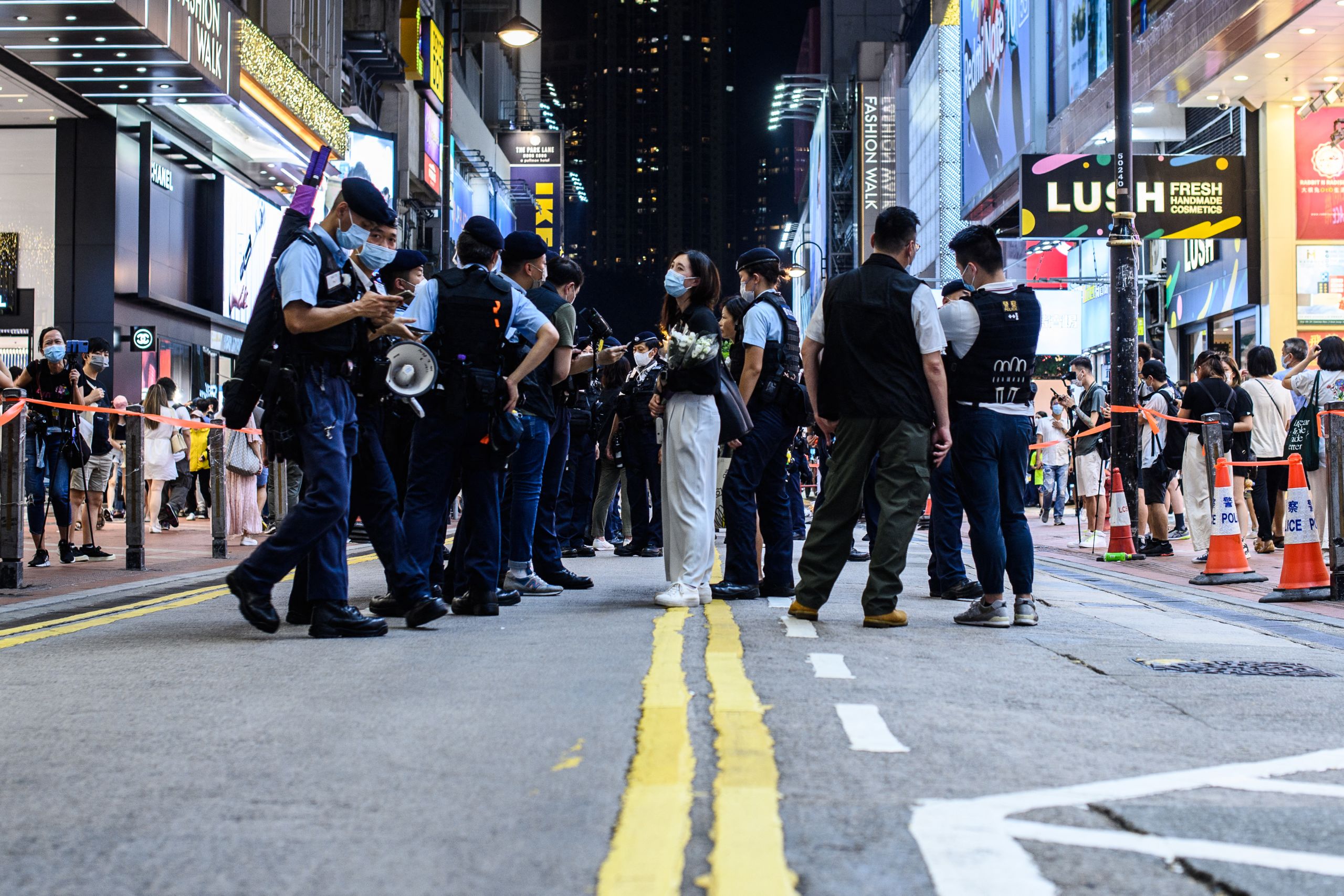
Hong Kong police searched the belongings of a woman holding flowers in a cordoned zoned at Causeway Bay. (AFP)
Hong Kong police searched the belongings of a woman holding flowers in a cordoned zoned at Causeway Bay. (AFP)

"Suppress the riots," Hong Kong police proceed and the Liberation Army gets closer

As a colonial police force, the Hong Kong police have always been very professional in suppressing mass movements.
After the civil war, the leftists of the Chinese Communist Party and the rightists of the Chinese Nationalist Party (Kuomintang) both set up peripheral stronghold organizations in Hong Kong to maximize grassroots-level influence, especially with immigrants and laborers, in order to influence the British Hong Kong government and to completely expel the other side's forces. In 1956, a rightist trade union used the Hong Kong government, sending people to unload red flags in a public housing resettlement area. They started to set up checkpoints across Kowloon to intercept traffic and attacked leftist trade unions. Even if the Hong Kong government’s report later proved that the riot was not premeditated and that the instigator was the local pro-Taiwan triad, not the Kuomintang itself, the Hong Kong police and British troops in Hong Kong still paid the heavy price of 59 deaths.
The Hong Kong police immediately deployed additional manpower and resources to increase their ability to suppress violence. Ten years later, when the 1967 Hong Kong Riots (the riots launched by the leftists in Hong Kong against the British Hong Kong government under the influence of the Cultural Revolution) broke out, even the leftists were directly under the leadership of the CCP’s Hong Kong and Macao Working Committee. They had a more compact organizational system and equipment spread all over Hong Kong. The "battlefield hospitals" and "munitions factories" in the leftist schools of major universities and shopping malls upgraded their methods from the weapons of 10 years ago, such as wooden sticks, bamboo sticks and knives to rifles and hand grenades. The Hong Kong police remained deployed and with the cooperation of the British Hong Kong Army, the riots were successfully suppressed. During this period, less than 20 demonstrators died during the confrontation on the streets.
For decades thereafter, the Hong Kong Police Force has been a model police system for other Commonwealth nations to learn anti-riot strategies.
In contrast, the mainland did not adopt the use of guns with live ammunition to suppress mass movements, only using guns to "intimidate the people," until the Tiananmen Square Massacre on June 4, 1989. However, the economic and social costs it brought were too high, and it was necessary to find a balance between peaceful negotiations and bloody suppression. On the other hand, China was still in the early stages of reform and opening up. It also depended on overseas investment and a good international environment and was unable to withstand the June 4 scenes appearing again. The paramilitary forces sent in were subordinate to the Central Military Commission and not connected to the Chinese People’s Armed Police Force. So it was clearly defined as "defending the security of the regime" –– the violent agency responsible for suppressing mass movements, and more than 30 years later in Hong Kong.
However, with the exception of some troops stationed in Xinjiang and Tibet, most armed police in the mainland have had little experience handling large-scale mass movements in the past three decades. In contrast, the Hong Kong police have gone through the Occupy Movement led by "peaceful, rational and non-violent" demonstrators in 2014, as well as the 2016 New Year’s fishball revolution in Mong Kok by local brave demonstrators. The Hong Kong police substantially expanded their anti-riot manpower after 2014. Under the Organized Crime and Triad Bureau, commonly known as the O, a permanent department to respond to mass movements was added.
If using the same force, the regular soldiers deploying to the south, lacking in regional experience, may not be able to "stop violence and control chaos" more successfully than their Hong Kong colleagues. If live ammunition is to be used to suppress, why would the central government take the initiative in the face of international pressure instead of entrusting the Hong Kong police with a monthly income of tens of thousands of yuan per capita to "do it for you"?
At the end of July 2019, Beijing considered sending troops to the south. Perhaps it was more worried about the political unreliability of the Hong Kong police than "inadequate capabilities," and even more worried about uncontrollable situations such as the police force's mutiny under "headwinds of public opinion."



"Re-Politicization" of the Hong Kong Police Force
However, after two years, facts prove that the Hong Kong police will not be "politically unreliable."
Since the 1990s, the Hong Kong Police Force has gradually transformed from a "paramilitary force" to a "service-oriented police" in response to the increasing stability of the social environment. The internal culture in the police no longer emphasized the conscious struggle to distinguish the enemy from itself. Although since Li Mingkui took office as Commissioner of Police in 2003, the Hong Kong Police Force and the mainland's communication grew increasingly close, but most of it was limited to Beijing's "political censorship" of high-level officials. As for basic-level exchanges, it was the same as the "Youth Exchange Groups" at that same period: it was just a feast of eating, drinking and having fun. Beijing’s most important "political education" against violent organizations had been absent in Hong Kong.
In 2014, the Seven Dark Corners incident broke out. During the Umbrella Movement, seven police officers dragged demonstrators to a dark place in Mong Kok to lynch and beat them. Among them, police officer Zhu Jingwei and others were convicted in 2016. The police force’s internal "unity and self-preservation" voices and antipathy towards pan-democratic forces rose up. However, in Beijing’s view, this is still just the righteous indignation based on comradeship, no different from the spontaneous resistance of Chinese vigilantes against the Japanese during World War II. If it is not clear "for whom and why we fight," the Hong Kong police is just a united front and not reliable as a "force defending the white area [a KMT controlled area during the Second Civil War]." Looking back at Xi Jinping's visit to Hong Kong in 2017, he visited the Pat Heung Junior Police Call training camp, and facing the police officers who met with him asked, "Are these officially hired police officers? Did they go to the police academy?" with clear disdain for the Hong Kong police.

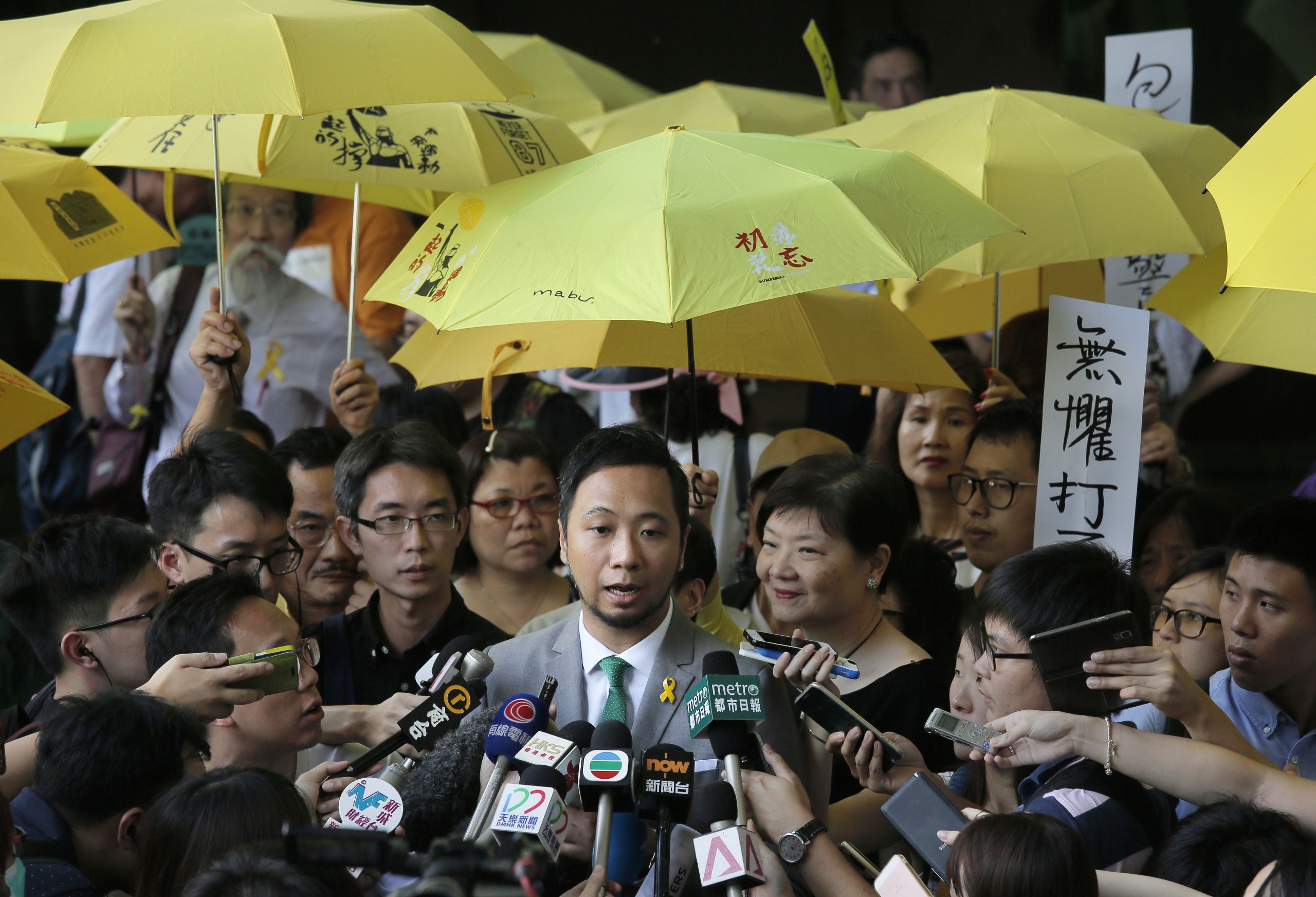
Victim of the Seven Dark Corners incident, Tsang Kin-chiu, who was physically assaulted by the seven policemen for four minutes, was found guilty of three counts and sentenced to jail. (AP)
Victim of the Seven Dark Corners incident, Tsang Kin-chiu, who was physically assaulted by the seven policemen for four minutes, was found guilty of three counts and sentenced to jail. (AP)
After the July 21 Yuen Long incident [dubbed the 7.21 incident], things began to change. After the parade and rally in 2019, more than a hundred people in white who were suspected of organizing and mobilizing in various villages armed with weapons, indiscriminately attacked and beat passers-by, including the elderly, weak, women and children at the Yuen Long MTR station. These were believed to be aimed at attacking citizens who were returning from participating in the demonstrations on Hong Kong Island. The incident occurred in the subway station where citizens come and go. News media broadcast live the whole ordeal, which had a great impact on people. At the same time, heavily armed policemen huddled in the police station and received a large number of alarm calls but did not act. They didn’t act until 49 minutes after the incident, and so were late to the scene and a large number of citizens had already been attacked. Later, officers at the superintendent level were photographed hanging around with the white-clothed assailants, their arms casually draped on each other’s shoulders and having a good time.


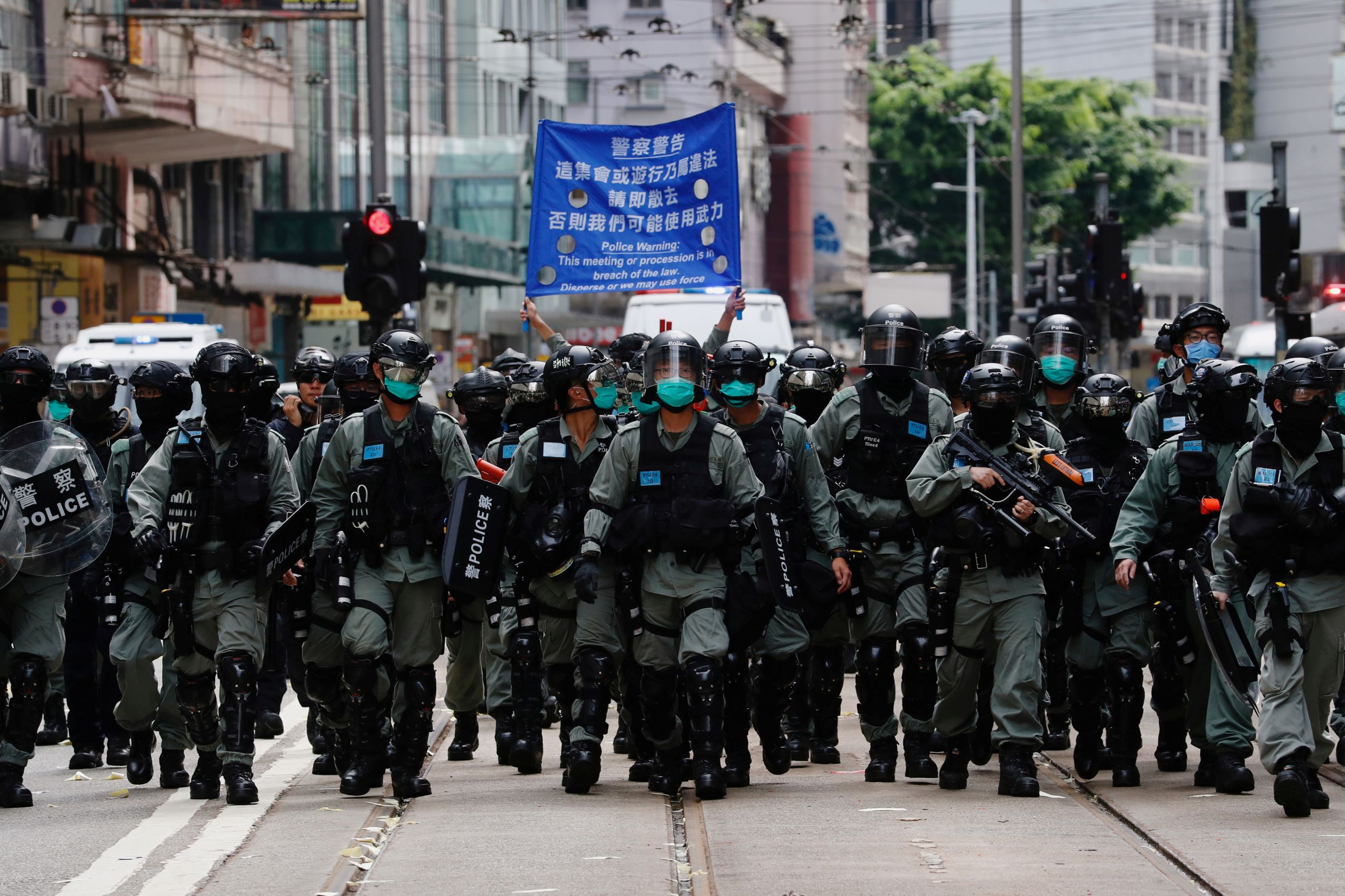
Riot police try to disperse protesters in their anti-extradition bill march near Mongkok, Hong Kong. (Reuters)
Riot police try to disperse protesters in their anti-extradition bill march near Mongkok, Hong Kong. (Reuters)
The police may have originally planned to reclaim the public’s reliance on order by creating a "time without police." As a result, this action was regarded by the public as different from law enforcement against dissidents, and reflected the inability of the police to perform their duties, to work professionally and to fairly protect citizens. As a result, this incident pushed the movement to a new climax and replaced the Carrie Lam government with the police force as the main target of the demonstrations.
The Chinese University of Hong Kong conducted a follow-up investigation on the public's trust in the police during the anti-extradition law campaign. In a poll after July 21, respondents who had zero trust in the police jumped from 22.5 to 42.7 percent; the percentage of passing scores rated "five points and above" dropped from 54 to 33 percent. In addition, a telephone poll conducted by the Hong Kong Democracy Research Institute also showed that about 66 percent of respondents agreed with the statement that "the police cooperated with the mafia in the 7.21 incident," while only 23 percent opposing it.

In the 7.21 incident, the white-clothed assailants were photographed talking to riot police in Yuen Long after attacking demonstrators and passerby at the MTR station. (Reuters)
In the 7.21 incident, the white-clothed assailants were photographed talking to riot police in Yuen Long after attacking demonstrators and passerby at the MTR station. (Reuters)
Trust in the police force completely broke down, and tens of thousands of local police officers were quickly isolated in their daily lives. In this situation, most police who chose to remain in the force desperately needed new values to rationalize their behavior. At the same time, as demonstrations in Hong Kong became increasingly fierce, the physical "us versus the enemy" became increasingly clear, and finally reached its peak with the Chinese University Defending War and the PolyU Defending War incidents in November, which naturally strengthened the police force's "us versus the enemy consciousness" and "battle consciousness".
On the other hand, Beijing, which had no license to play at that time, had no choice but to unconditionally support the police force’s "guns," even at the expense of the nominally higher-ranking SAR officials. After the 7.21 incident, Chief Secretary for Administration Zhang Jianzong apologized for "not sending out the police in time" when answering a question in the Legislative Council. Later, at a police officers' junior association, commonly known as the San Tsai Club (basic police officers club) Zhang was requested that "if his ability is insufficient, to leave his office and for the virtuous good of both civil servants and the people of Hong Kong." Later, Zhang was forced to shift his position, which also made the police understand that Beijing, not the SAR government, is its power base, and thus more enthusiastically embrace the new position of being "the CCP's knife."
As Hong Kong entered a new era of national security laws, Beijing did not follow the example of the British government. It placed personnel appointments and operational details of the Political Department of the British Hong Kong Police Force in charge of intelligence and special tasks directly with MI6 instead of the Royal Hong Kong Police. Under the command of the National Security Agency, the existing police department system is allowed to set up the National Security Office, which will take over most of the operations of the National Security Office from various departments and provide intelligence support.
Unlike political cases in the mainland where state security and national security under the National Security Bureau have different specific responsibilities, every police department in Hong Kong has more or less participated in national security law enforcement in the past year. Most of the police who searched the Apple Daily building on June 18 this year came from the full-time riot police tactical unit; the Commercial Crime Bureau also took over the "Xinghuo" and Jess crowdfunding cases; even if it was not usual, police also took orders, even raiding the "porn shops" of the Abutai Life Department Store. This arrangement highlights Beijing’s trust in the Hong Kong Police Force, and also reveals Beijing’s desire to further "politicize" the Hong Kong Police Force.
Stability thinking replaces law enforcement thinking
In addition to strengthening the "struggle awareness" of the Hong Kong Police Force at the ideological level, Beijing has also continued to export the methodology of violent suppression to Hong Kong at the technical level in the past two years.
In the history of the Hong Kong police, they had never dealt with a large-scale suppression task such as those in 2019. During the October 10 Riot and the 1967 Riots, the "brave factions" faced by the Hong Kong police were political fanatics who accounted for only a sliver of the workforce. By the time of the 2014 Occupation Movement, the mostly peaceful movement had caused the police to hold military drills again. In the end by "cooperating with the bailiff to enforce the injunction order," this wound down. In fact, looking at situations around the world where police use deadly force to suppress brave groups, this mostly gets citizens to support the "thugs."

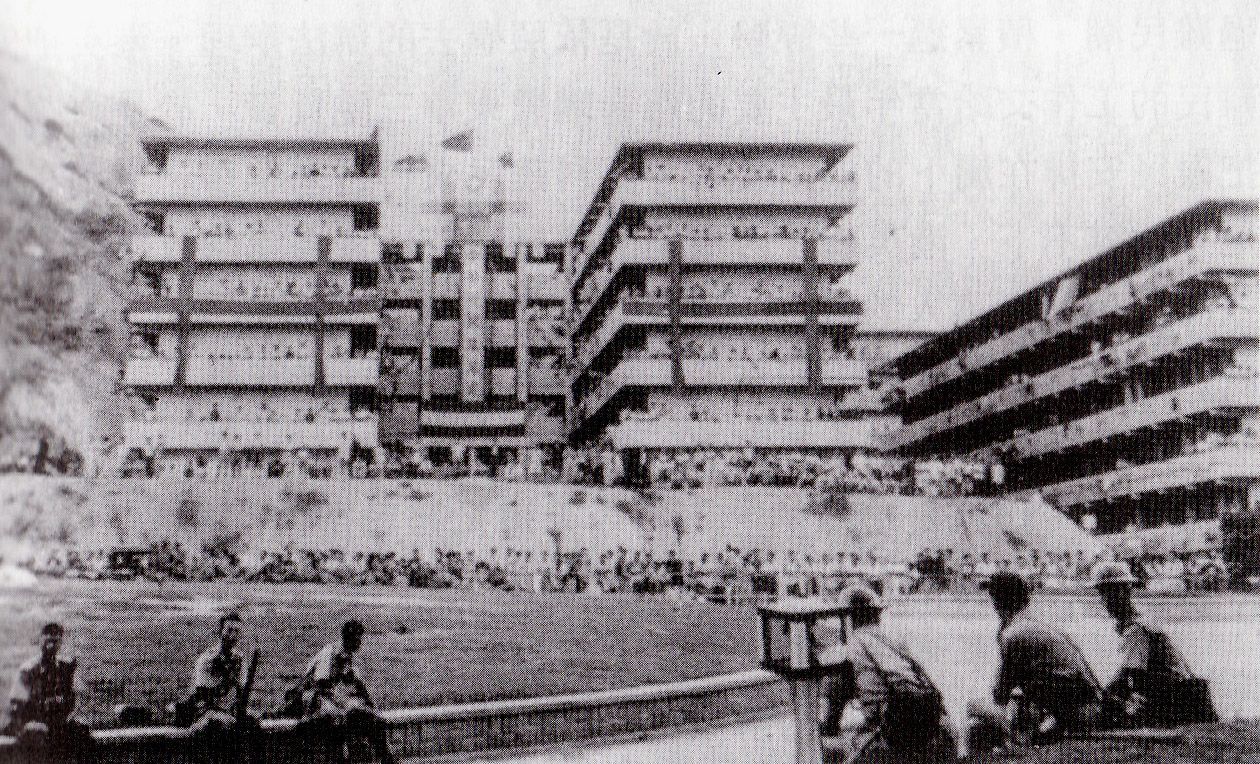
During the October 10 riots, the police riot team confronted the masses in the Shek Kip Mei resettlement area. The large "Double Ten" emblem hung on the outer wall of Block H (now Mei Ho House) is seen. (Wikipedia / Zhou Yi 香港左派鬥爭史)
During the October 10 riots, the police riot team confronted the masses in the Shek Kip Mei resettlement area. The large "Double Ten" emblem hung on the outer wall of Block H (now Mei Ho House) is seen. (Wikipedia / Zhou Yi 香港左派鬥爭史)
For this reason, in the early days of the movement, the police were mostly exhausted when facing the guerrilla tactics of the demonstrators. Not only were they unable to arrest most of the demonstrators, but because the police repeatedly broke into the mall and dumped tear gas everywhere, they frequently frightened citizens. It was not until the end of 2019 that Deng Bingqiang took over as Chief of Police. He took the initiative in the PolyU campaign by taking advantage of the demonstrators’ persistence in "positional warfare" and used the CCP’s "encircling an enemy to attack the reinforcements" tactic.


A poster by an unknown artist with "Be Water", a slogan often used amongst protesters, was distributed and circulated on Telegram. (Telegram / Unknown)
A poster by an unknown artist with "Be Water", a slogan often used amongst protesters, was distributed and circulated on Telegram. (Telegram / Unknown)
"Encircling an enemy to attack the reinforcements" means that the enemy surrounds a town to use it as a bait to attract reinforcements from other places. Its real purpose is to fight the reinforced enemy and annihilate the aid. During the civil war between the KMT and the CCP, the CCP used this method to win on the battlefield such as during the Battle of Qingfengdian and the Battle of Eastern Henan.
The police besieged demonstrators inside Hong Kong Polytechnic University and arrested a large number of protestors who came to support them. More than 1,100 people were arrested. As a result, street protests cooled down, and after the COVID-19 outbreak in February last year, the frequency and number of public demonstrations further decreased.
Taking advantage of the departure of "peace, rationality, nonviolence," the police force also introduced new thinking of "violence suppression": imitating the mainland’s "stability maintenance thinking" of pre-prevention, instead of the "law enforcement thinking" of post-event handling.
As early as 2013, when China’s online speech was not too heavily censored, Gary King, a professor of political science at Harvard University, stated in his paper "How Censorship in China Allows Government Criticism but Silences Collective Expression" that China’s internet regulatory authorities would not target those that criticize the government's speech, but any content (whether it is positive or negative about the CCP) that may trigger collective action would be strictly reviewed or supplemented with "public opinion guidance." Vigilant "collective actions" include not only political gatherings of different factions, but also incidents related to labor rights, women's and minority rights, as well as commercial rights protection incidents that are common throughout the country.
Examples cited in the paper include online support for Wenzhou environmentalist Chen Fei. Chen Fei vowed to support the environmental lottery to protect the local environment. Although this attitude was supported by the government, all online posts about him on the local website were deleted, probably because he organized group activities in the past. The lead poisoning of children incident in Shuyang, Jiangsu, was also deleted. Deleted posts also discussed the contamination of children’s health caused by Tianneng Group’s battery factory, and that the hospital refused to release test reports to the parents of the victims. On this matter, in January 2011, Shuyang villagers asked for an explanation in front of the factory. The paper’s conclusion is that the most rigorous content of online censorship is not criticism or discussion of national policies, but local groups that may cause groups to gather to express their opinions.
In Hong Kong, from 2019 to early 2020, the police would allow crowds and illegal behaviors to launch their suppression strategy, turning to the strategy of "prohibiting all buds that may trigger group actions." Although Hong Kong does not yet have a grid-based stability maintenance system like the mainland that can nip problems in the bud, taking this year’s June 4 candlelight vigil as an example, the police did not hesitate to publicly display water cannons that had not been seen for a long time in order to scare off participants. Obstacles were set up at three cross-harbor tunnels in Hong Kong at the same time, and uniformed police officers were dispatched to patrol the Victoria Park and Causeway Bay to intercept young passers-by. On June 12, the second anniversary of anti-extradition bill protest, even though there was no call for action, the police sent more than 5,000 police officers to patrol the busy districts, creating a chilling effect. Whether it is June 4, which is considered to have a strong significance in "Greater China" complex, or June 12, which has more local significance, as long as it could cause crowds, it will be restricted.
In addition to dealing with traditional demonstrations, this experience also extends to all occasions that may cause people to gather. On May 29, a documentary related to June 4 was broadcast by the staff union of the Hospital Authority, which had been warned by the censors. Some groups planned to hold a low-key screening on the eve of June 12 and received warning letters in advance. As for the Stake June 4 Memorial Hall, it was ordered to close because it did not apply for a public entertainment license.
In order to avoid organized behavior, the Hong Kong police also borrowed the mainland’s experience of maintaining stability and focused on cracking down on "influential figures" rather than "radical speeches," and made every effort to split up social individuals.
All political and social figures who may have influence, regardless of their stance and previous behavior, can be charged with felonies and priority liquidation [typically when a business loses its assets during insolvency]. Just as the mainland sent Liu Xiaobo, Ilham Tohti of the Uyghur Minzu University, and even Xu Zhiyong to prison after 2008; some young people in Hong Kong, including Yang Sen and He Junren, who were previously disapproved by some young people as "moderates," were also sent to prison. In the early morning of June 4, Chow Hang-tung, Vice Chairman of the Stake, was arrested. She was imprisoned again before July 1 after she was released on bail. A new generation of young political organizations with relatively fierce speeches in the past, such as the youth organization Student Politicism – although frequently targeted by the authorities before, its influence is not wide, and it had not been the target of the local pro-organizational media, institutional forces, and the police before. However, they were also arrested before their planned street activity on July 1.
With a battle mentality and improved methods for the struggle, the Hong Kong Police Force has finally become a capable patriot in Beijing's eyes. In the future, it will also become a model for other departments and "loyal garbage" to learn from.


 Built with Shorthand