
Commentary
Autobiography: A Letter to the Future–
A Former Journalist's Memory of a Night in the White Paper Movement
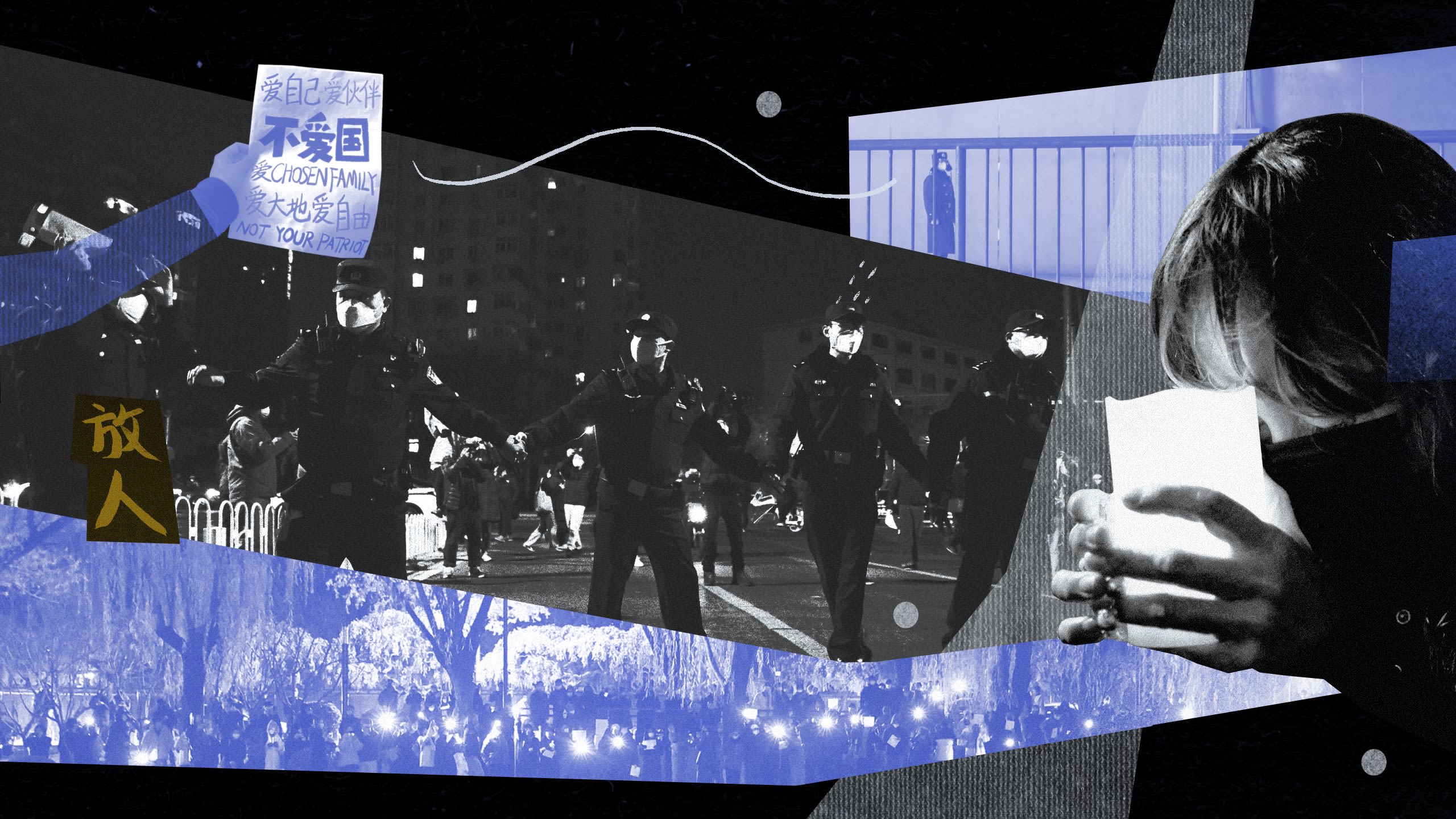

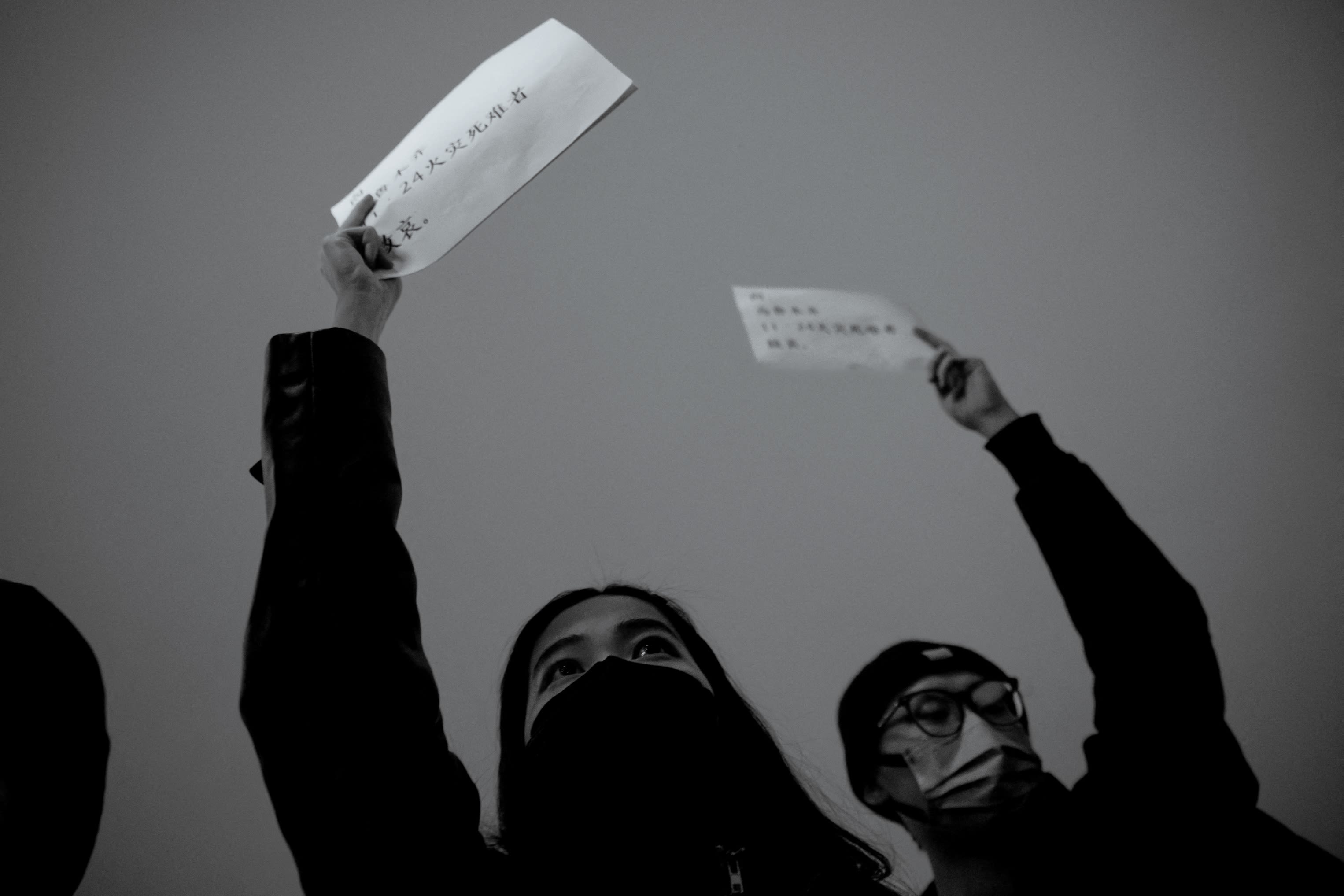
EDITOR'S NOTE: On November 24, 2022, while China was under a pandemic lockdown, a fire broke out in Jixiang Community in Urumqi. Officials claimed that 10 people were killed. In the following days, protests broke out as people in Shanghai, Beijing, Chengdu, Guangzhou, and other cities spontaneously gathered to pay homage to the deceased and express their dissatisfaction with the COVID-19 eradication policy and to make other political demands. The author of this article, Lin Xuxu, was at the scene of the protest. She used this autobiographical essay to recall her memories from a year ago.
To be honest, I don't really want to write a letter to you, I just need to imagine you sitting across from me so I can feel a little more comfortable to speak up.
Recalling what had happened that night is painful. I have been wanting to write it down, but I didn’t have the courage at first, and now my memories begin to fade. I miss the photos and words that I had to delete to keep myself from trouble back then.
1
That evening, we had dinner at your house. One thing that sticks out in my memory is that the food was terrible that day. Beijing continued to be under lockdown. We could no longer tell which restaurants were still open; we couldn’t order takeout, and we had to wait for an hour or two for delivery. We had no choice but to ask our friend Y who was still out on the streets to grab whatever he could find from a restaurant that was open. In the end, he brought two large boxes of Shaxian steamed dumplings. When it was served, everyone laughed.
Of course, our gathering that day was not just to share a meal. The night before, large-scale protests had broken out from Nanjing to Shanghai. Students from Nanjing University of Communication stood in solidarity, holding pieces of white paper to observe a moment of silence for the compatriots lost in the Xinjiang apartment fire. From those video fragments, we saw students negotiating with the University President and demanding that "no one should receive repercussions afterwards." Some media veterans said that if these students are harmed because of this, they hoped that everyone will help them when they are looking for jobs in the future.
I felt very emotional when I heard this comment. I used to be a student and I experienced that kind of awful life: fear of being reported, being called in for a talk, fear of not being able to graduate, fear of losing the opportunity to enter this industry. I am no longer a student, and I don’t have any weaknesses to be targeted anymore. But in the end, it was the students, who had nothing, who stood up first.
That night, Y shared a location on WeChat Moments: Urumqi Office in Beijing, saying he would show up there.
I must confess that I was undecided whether to go to the site from the beginning. A month before this, I had just made a new life plan, hoping that I could live a good life. I must admit that there were some moments when I kept convincing myself, "It's just a walk, nothing will happen." "If I were met with the police, I'm just passing by, so what can they do to me?"
2
Did we talk about anything else that night? I don’t remember. Then I went out. Before I went out, I picked up a down jacket from your house.
We arrived very early and first went near the Lebanese Embassy, only to find a police car parked there. We were so frightened that we quickly asked the driver to keep driving forward. The weather was very cold, and there were very few people walking along the Liangma River, but soon I found some young people pacing back and forth like us. I made eye contact with a group of them, and then asked: "Are you here for a walk?" The other party said yes, and we started walking by the river together.
We used to take many walks along the river. It was still 2021, and the section of the Liangma River in the Embassy District had just been repaired. The officials were trying to make it a beautiful and accessible business district. We spent the Mid-Autumn Festival that year drinking under a white shed. By 2022, the place suddenly became popular. People who had nowhere to go due to the lockdown came to the river to paddleboard, swim and walk.
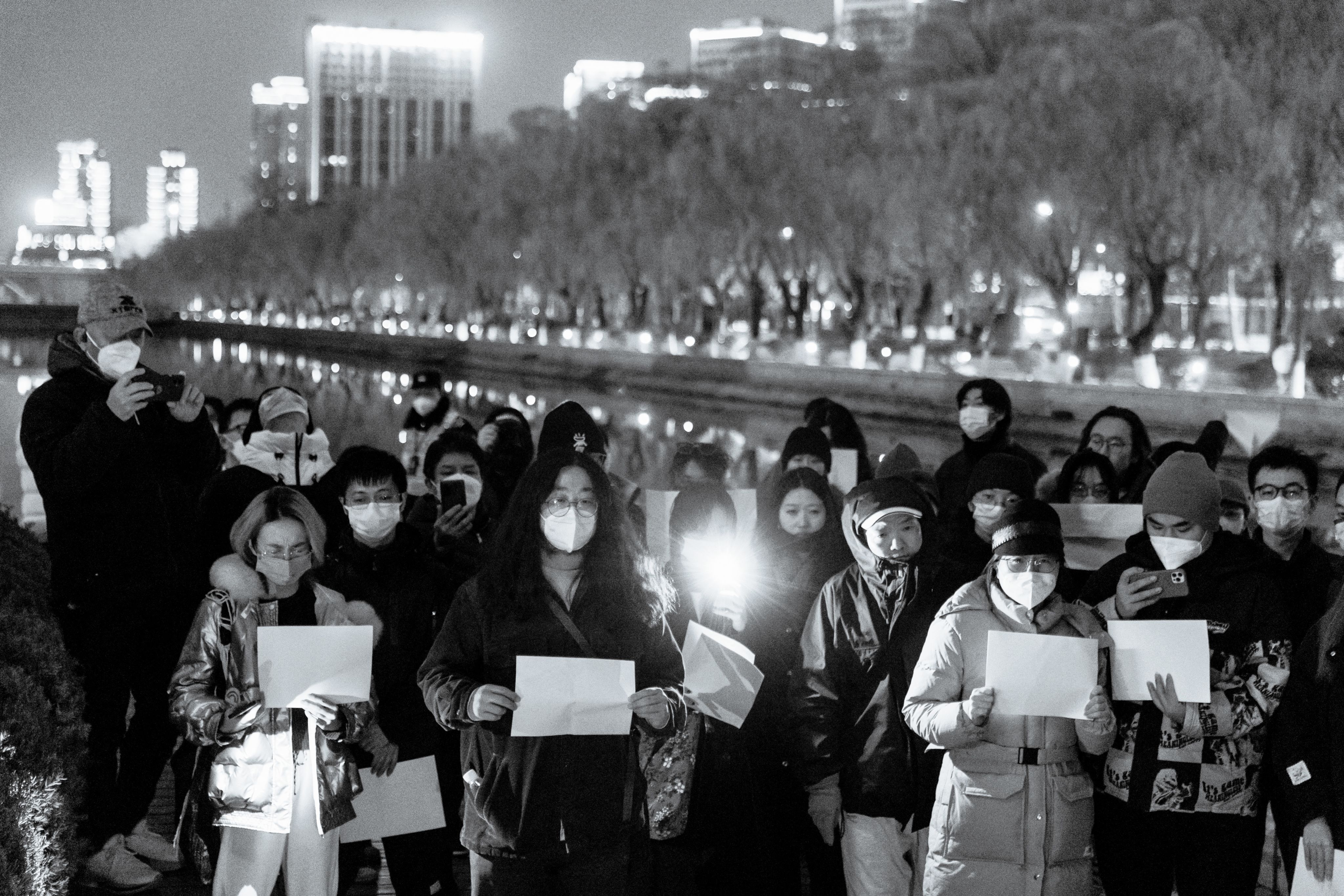
Around eight o'clock that evening, a few young people held flowers and placed them on a public bench. Immediately, two men in uniform came over and said that gatherings were not allowed here. We went to the other side of the river again. In front of a very magnificent hotel, we stopped along the river and put down flowers and candles, and then the hotel security came and said we were not allowed to light candles. By that time, all the people were already crowded on this narrow riverside trail.
You already know what happened next. The police in this country always arrive faster than anyone else. A young policeman tried to get us to disperse, for no other reason than gatherings are not allowed due to the Pandemic. Someone said, "Then we should pretend as if we were doing a COVID PCR test, standing one meter apart, but we’re lining up to mourn." Someone started to maintain order in the field spontaneously. People stood in three rows and kept their distance from one another.
In fact, we were all very well aware that it didn’t matter what the arrangement was. The truth was that we weren’t allowed to gather together.
The policeman kept saying that he understood our feelings, but still he couldn't let us be there. Many people were obviously suppressing a lot of anger. Someone asked the same young policeman: "Do you know why we are gathering here?" and "Do you know what happened in Xinjiang?" The policeman said that he didn’t know. Some in the crowd voiced their disbelief, "He doesn't know!" But I really didn't want to see that scene play out, because I didn't want another ordinary person to bear the brunt of our anger.
Later, there were more and more people, and there were more and more police cars and policemen. They surrounded both ends of the river. That was the most "relaxed" period of the whole night. To mourn, we sang songs. Someone suggested singing a song for the deceased compatriots, so we sang "Farewell." Later, the "Internationale" and "national anthem" were sung one after another. I sang very loudly. I hadn’t been able to sing karaoke for a long time, so I sang on the street.
We also tried chanting loudly. As expected, we were shut down: We shall not shout extreme words. I don’t know who took the lead, but we did the opposite. We shouted, “Good, good, good, good, good;” “The Chinese people are the happiest people in the world;” and “I want to do a PCR test.” Absurdity dissolves a lot of sadness.
A female voice far from the other side said, “I am from Xinjiang, thank you.” I think in my heart, we are the ones who have failed the Xinjiang people. There was also a man standing on the other side of the river shouting: “You make me feel that there is hope for Beijing.” I later saw some photos taken by the media from the other side of the river. The reflections of the crowds and mobile phone lights in the river were very beautiful.

3
A friend in the group was photographed by the police and had to leave the scene early. She and I walked away from the river and returned to the bridge, where we found that there were already police cars parked there.
Should I have left with her? There were so many "stay or go" moments that night. I decided to remain at the site.
More and more people were coming out from along the river. Police on the bridge constantly reminded the crowd not to gather on the bridge. At that moment, I felt compelled to shout: “Since we are not allowed to stay here, let’s start walking.”
Then another female voice was heard, "Is anyone coming with me?" So, the crowd gathered again. We started walking. That was the beginning of the march that night.
Foreign reporters flocked around us, carrying cameras and interviewing people on the streets. A female reporter stopped me, and her interpreter asked why we were taking to the streets and what our demands were. What did I answer? I don't remember at all.
I didn’t know how to express my demands. For people living here, “demand” is a word that is too unfamiliar and too dangerous. It is not mentioned at the dinner table, in the classrooms, in street signs, let alone in public media. So, I didn’t know what my demand was. I also didn’t dare to say what my demands were.
I felt very embarrassed and ashamed in front of the camera. On the one hand, we were standing on the street but didn’t know how to express our demands. That was ridiculous. I thought of the youth in Hong Kong and the youth in Thailand. Among the protesters in all regions, probably we were the most useless group. On the other hand, I had never asked such a direct question in my own career. I’ve also never been faced with such direct media.
Then I ran away from the camera.
I escaped from the first row back to the second row, then I deliberately walked slowly and fled a little further back. A girl next to me noticed my nervousness. She comforted me, saying: “It is ok.”
After walking a few steps, the crowd stopped and started shouting slogans. Were those slogans considered our demands? "The compatriots in Xinjiang should not be forgotten!" "The compatriots in Guizhou should not be forgotten!"
A young girl brought up the Sitong Bridge slogan and took the lead in shouting: "No PCR testing. We want freedom. No dictatorship. We want democracy..." A month ago, when the Sitong Bridge protest had just happened, many friends said at a gathering that the most depressing thing about the current environment is that what had happened on the bridge did not leave any impact except giving up one’s life. I nodded in agreement at that time. But on this night a month later, when the slogans on the Sitong Bridge were shouted out by so many people, they floated in the Beijing night. I understood this is the meaning. Every noise will create some echoes.
4
We walked from Xinyuan Street to Xinyuan South Road. A foreign photographer climbed up a telephone pole to take a picture of us. A colleague standing in the crowd said "Chinese reporters will sacrifice themselves and let foreign reporters win the World Press Photo Award" and we all laughed.
Why aren't we on telephone poles? Why can we only stand in the crowd? This seems to be our situation this year. We are no longer bystanders, and the professional experience we gained in the past was not very effective. As journalists we need to detach ourselves and should not get too close to the interviewees. But how do you separate yourself when you live here, when everyone shares the same pain?
Over the past year, I have done more personal writing than ever before. Occasionally, when I think about it, I feel ashamed. Why did I start writing about myself? But every time when an article was published, I found that these small and personal pains have gained so much resonance in the forum.
If we had the choice, we would have hoped that it was us who climbed up that pole.
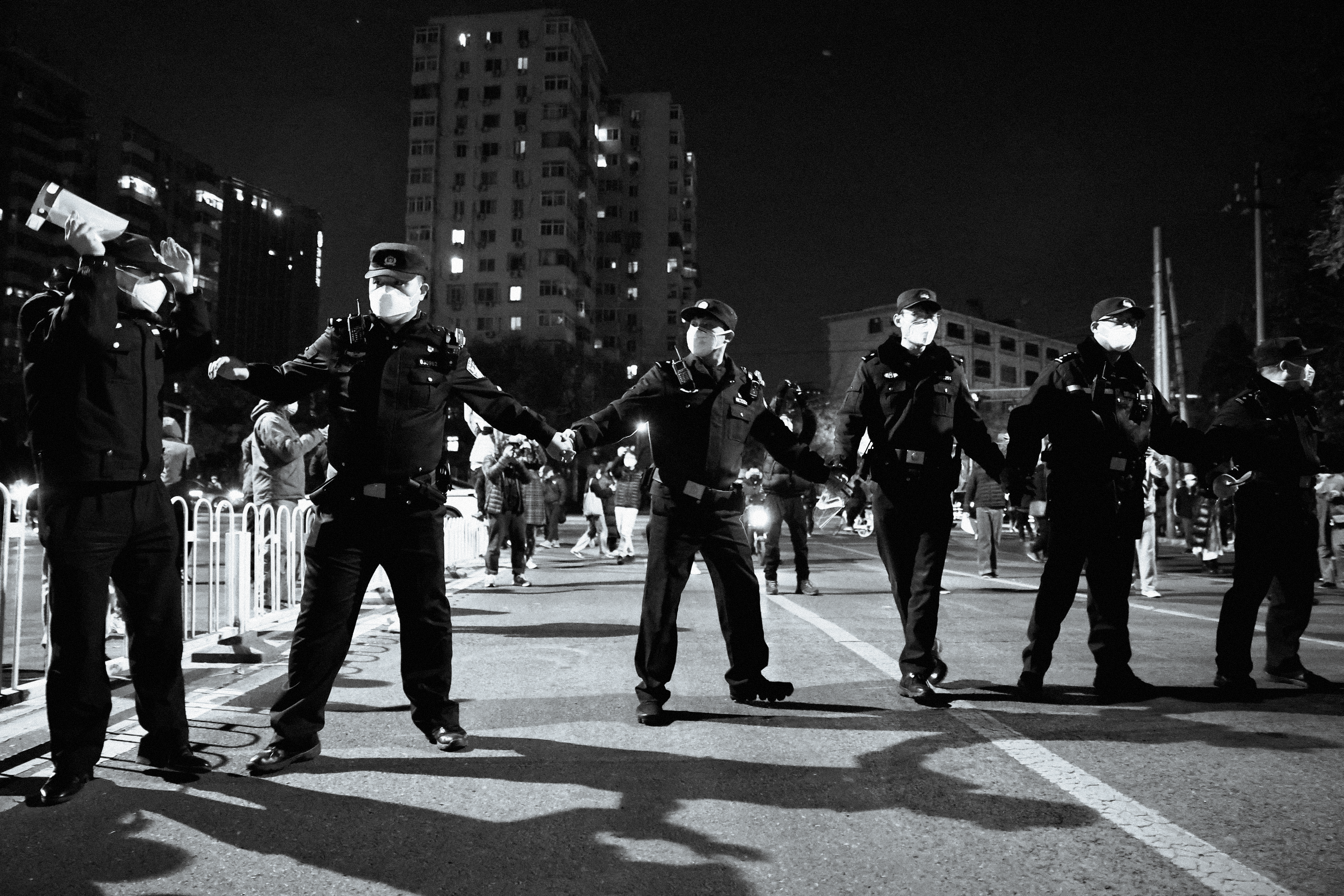
That night, the police had set up cordons at every intersection, and then we lifted the cordons and continued walking under them.
The crowd grew larger, and the chanting of the slogans became increasingly loud, so much so that residents of the community along the street came downstairs to watch. An elderly aunt gave a speech on the street. She said, "Everyone is a victim, and the dictator is also a victim of this era.” Behind her, someone started shouting, “Release Peng Zaizhou!”
Later, there were more and more police officers. To be more accurate, they were plainclothes officers, easily identifiable as they all wore N95 masks. At a certain intersection, they forced everyone to turn back. At all intersections, they forced people to make a choice: Do you want to exit at this intersection or stay in the march?
Accounts of the previous night’s experience in Shanghai had been circulating on the Internet, and people cautioned one another not to get separated and we must go home together. But I thought with great despair that at the march, there must be someone who stayed until the end, and there must be someone who went home last.
On that stretch of road, someone nearby almost got into a confrontation with the police. A policeman put his arm around the young man’s shoulder and said, “Let’s go chat.” Everyone gathered around them and wanted to stand with the guy, but I sensed another meaning from the policeman’s expression: he didn't want the conflict to intensify and things to become irreversible. Later, for some unknown reason, people turned back while shouting "Peoples’ police protect the people." The people who shouted those words at that time probably did not expect that not long after, we would once again confront those "servants of the people."
After that encounter, friends kept sending messages letting me know that they were on their way over. Since my friend who was accompanying me had some leg issues, she had to go home first. At that moment, I was once again faced with "should I stay or should I go." In fact, my best choice would have been to go with her. I didn't have a valid PCR certificate, so I couldn't take any transportation. I might not be able to return home.
But I stayed. To be honest, I just didn’t want to leave. After sending my friend off to the bus, I walked aimlessly by myself, wanting to go to a place with more people. Then I saw many empty buses approaching. We have learned from what happened in Shanghai the night before that they were police buses.
I took a detour and walked back to Liangma Bridge. When I was almost there, I heard the voices of many people again. It turned out that the young people who joined later had staged a second wave of protests on the bridge, but they had been separated and divided by the roads. Vehicles came and went, and an orange car drove past several times. The car stereo played the "Internationale" very loudly, and passing vehicles also kept honking their horns.
The police had cordoned off the scene and no one was allowed to join.

5
I didn’t know what time it was, but there were new messages on my phone. One of them was “Tear gas and police are heading towards the Third Ring Road.” To be honest, this news doesn’t seem like much now, but that night, I was so scared that I finally decided to leave. I scanned a share bicycle and rode in the wrong direction. A policeman asked me where I was going and pointed a direction for me. Maybe he might have moved the cordon? I heard him say, "Go quickly," and I left.
I finally decided to go back to your house. When I opened the door, you sat alone in the living room in silence. I didn't know what you were thinking. Out of fear, I stayed connected with another friend all the way home. After I got home, we didn’t talk much, and I fell asleep on your sofa.
Is this matter over? The next day, I left your house. When I was near the subway station, I saw a piece of paper taped on the ground. On it were the names of many cities and "We stand with the Chinese activists." I felt excited.
My life didn’t seem to change after that. I still relied on the screenshots of Health Kit to get on the subway. For several years, every day, I had been following those singers and articles that disappeared. I was angry at the inability to speak up in public domains. I had wondered before if there would be a day when people would be expelled from the community just because they expressed different opinions? For example, they will not be able to enjoy public resources, take the high-speed rail, or be hired. They will be excluded from the social order. At that moment before the Spring Festival, it suddenly dawned on me that aren’t we living a life similar to exile? You didn’t even do anything wrong, but you just can’t take public transportation as you wish or to go to public places.
And then we got those calls. Calls from police stations of different jurisdictions: Where were you on the night of the 27th? Who were you with? What did you do? Were you there?
Almost every few hours, I exchanged messages with those friends who had been to the march. We tried to come up with some sort of a story, but we were really bad at lying. We were accustomed to remembering every detail from a scene. When I first started as a reporter, a senior taught me to turn myself into a video recorder and record everything I saw at a site. I also had to open up all my senses — to smell a scene, to listen to its sounds. We spent quite some time to go over what had happened that night, but we couldn't come up with a credible story to deal with the police. Then we reached a consensus that we should not reveal one another's names, and we could make up the rest. We’re on our own.
My call came late at night on the third day. (I later learned that the police had come for me during the days for two days in a row, but I wasn’t at home.) I didn’t answer the phone; I just watched it ring until it stopped. Then a new number called. Although I felt I was prepared to face the police, I actually wasn’t. I could hear my heart beating so very fast.
I decided to start with deleting a few photos on my phone as well as many videos about rallies in other cities, and later I deleted a lot of chat history. I then started deleting friends’ contacts.
It was actually very late at that time, so I forced myself to fall asleep, and I would face the police the next day. I woke up very early the next morning. I saw that the police had made another call, but I still didn’t answer it. I wasn’t avoiding it. Do you know what I was thinking? I just wanted to have enough sleep. I thought about those friends who had been detained for quite a long time but haven’t been released. I thought that if things get to that point, it will be very painful to not be able to sleep, so I wanted to get enough sleep now.
I later saw the widely circulated "Letter from Tehran Prison." The author said that she had just acquired a few records before going to jail, and it was very hard to let go of the petite bourgeoisie lifestyle. I very much feel the same way. I think I am really spoiled now. I need fresh milk and fresh fruit. If I really end up in a detention center, I would be in extreme despair.
I slept until noon; I had no idea how I could have slept at all. Only then was I finally ready to get up and face it. Sure enough, I received another call not long after I got up, and the caller asked me to go to a certain police station.
It was very cold that day. I delegated my work to someone else before heading out. I didn’t use a navigation system and thought I could find the police station, but I took a wrong turn and ended up walking for more than half an hour. I felt a little tired and wanted to find something to eat. But I didn’t have a PCR test certificate, and Beijing hadn’t yet lifted the ban on dining in. After all, I wasn’t able to grab a bite before going to the police station.
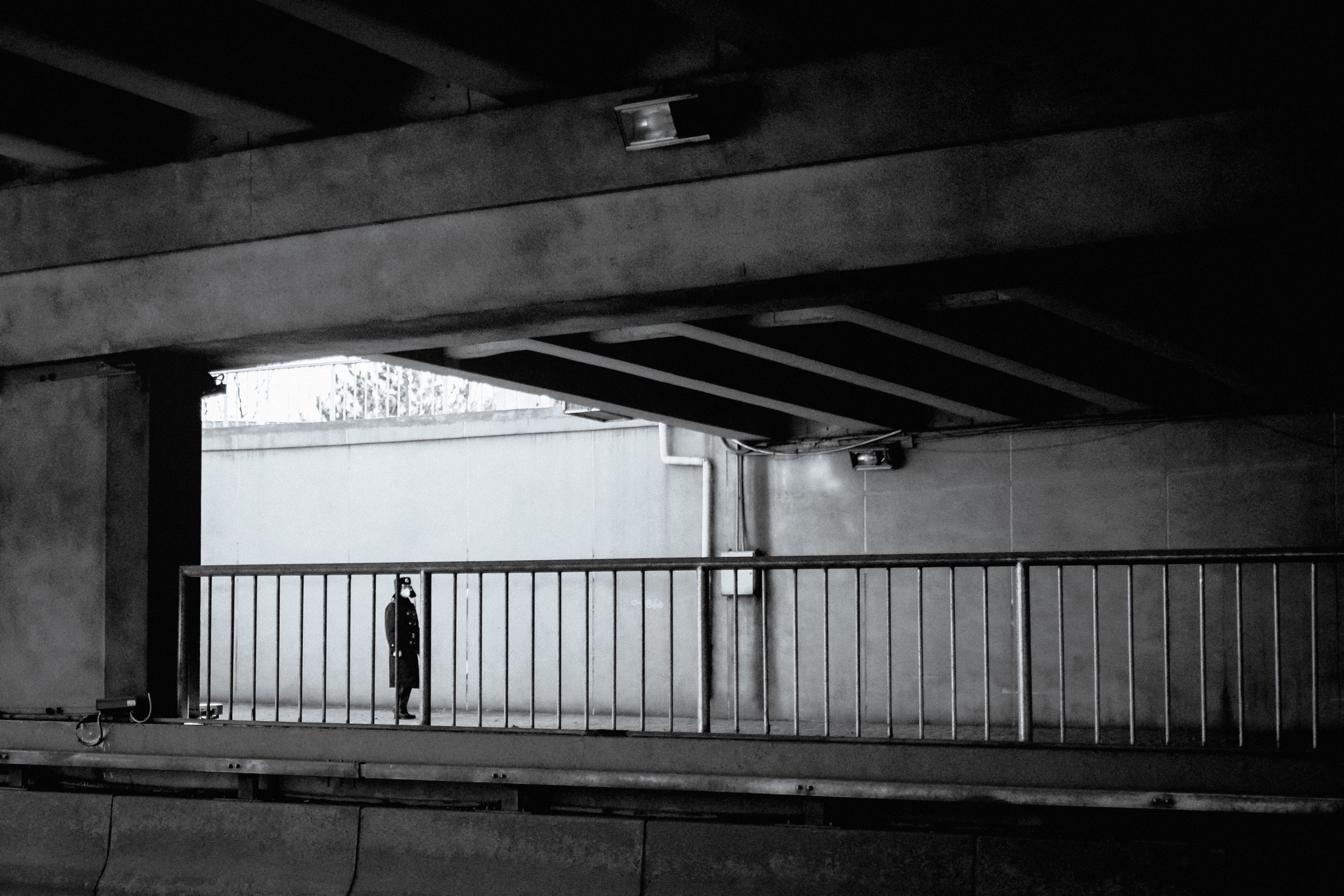
I'd been delaying it for so long, but never would I have expected that because the "zero COVID" mandate that was still in effect, I couldn’t enter the police station without a mask and a PCR test certificate. Eventually, the police brought out a chair, sitting at the top of the alley, and took down my answers to his questions. Then the matter came to an end for the time being.

6
The issue seemed to be dropped, right? Miraculously, they actually let it go.
Suddenly, there was no need to do PCR tests. People were forwarding photos of PCR test kiosks being torn down. All of a sudden, we didn’t know to whom should we direct the suppressed frustration and anger accumulated over the past three years. What have we been doing over these past three years? We got locked up when ordered, and we got let free when ordered .
The whole city went dead quiet again, and this time it was completely lifeless. People were either lying in bed or rushing to the hospital. I lay in bed every day and didn't go out for a week. I looked out the window and there was not a single car on the usually congested ring road. Occasionally, a few ambulances whizzed by.
The bad news came just before Christmas. Journalists in Beijing were being arrested. But it was so bizarre. Our industry did not mention a word. When some colleagues proposed to follow the story, other colleagues voiced their concern, "maybe not covering it is the best protection we can provide?"
Is this really our normal logic? When reporting, don’t we always say that attention is power? How come when reporters were being arrested, it became “No attention is the best protection.” I don’t mean to criticize anyone, and I knew that at that point, many people subconsciously remained silent.
I was really afraid that people who were arrested would be forgotten again. Maybe I projected my own consciousness — I was afraid that if I had been arrested, my friends would forget about me. We talked about it that night, and you said that you had given it some thoughts. If you got taken away one day, you would hope that your friends will continue to live happy lives, such as going to your favorite restaurant to enjoy a meal together.
I had imagined whether it would be possible for everyone to stand up again but this time to support our colleagues. I also imagined that if everyone who had been to the march turned themselves in and confessed, then it would have meant that everyone was innocent. But I also knew that these things were impossible. Most people were preparing to get their lives back on track, and they would not want to go back to stand up for anyone. And a night like that only comes once.
The friends I have met over the years can be divided into two categories. One category is those with a civic spirit. They are kind, brave, have things they love, truly care about what is happening in our society and will fight for freedom and equality in many small ways. Then there is another type of friend that you will recognize from your first meeting. They are so determined that they may one day sacrifice themselves for the sake of freedom.
We all know that those young people arrested in Beijing did not actually want to sacrifice their lives. I was a little hysterical during that time. On the one hand, I was not sure whether I was safe. On the other hand, I always felt that they were the "scapegoats" who were bearing the punishment for everyone who had been in the march, even if the crime and punishment were both unjustified.
Later, more and more news came out. Some people said that the police followed leads from an overseas group and arrested people, while others said that they were arrested just because they were photographed by foreign media. I became more and more like a frightened bird. Phone calls with unknown numbers made me nervous for a long time. I kept thinking about what I had done. My face and voice were clearly identifiable on so many foreign media broadcasts. What could I do? Well, there was also that damn street interview. I wondered if it would be broadcast.
There was a period in which no more arrests were made, and you kept telling me that everything was probably fine. I kind of knew that they likely wouldn’t find me. But my body was still very tense, and I started vomiting again for no reason. I had no choice but to dig out the sedatives prescribed by the doctor in the first half of the year.
I knew that I should delete all the records, those photos and those videos, but I also really wanted to write it all down. I was more afraid that there would be no records left at all. Usually, we care so much about hearing the voices of those who have experienced things firsthand. This time, we also should write down for ourselves exactly what happened.
During that time, I even started to seek out answers to some very strange questions, such as, can people choose where to go to jail? Can people with criminal records still travel or study abroad, and can they apply for a visa? The answer was that it is no problem to go to most countries, and I felt relieved again. Later, I alternated between fear and resignation. I would think that it’s not easy to make a living outside, so it wouldn’t be such a bad idea to go to jail and wait for my friends to give me a few books every time they visit me.
When Chinese New Year was rapidly approaching, because one of my close friends was arrested, friends kept telling me, "Go, get out of here." Everyone urged me to go. A senior journalist who had previously had disagreements with me would call me almost every few days. She said, you know I don't like you very much, but I hope you are safe.
During those days, even when I went out to buy a sugar cane, I would carry my computer and passport with me. I didn’t know what use it would be. If the police really came to my door at that time, would I have the courage to run away with my computer and passport? Probably not. But becoming a "fugitive" had unconsciously creeped into my state of being. This reoccurred many times, such as at Xianzi's court hearing, when walking under the Sitong Bridge, or when sneaking into a demolished village, or even when I hopped on a bus with a fake PCR test certificate.
7
Nothing "happened" to me in the end. At this moment, I am sitting peacefully in a cafe near the southern hemisphere. It seems like I finally don’t have to worry anymore. There are big bright windows, big wooden tables, countless ferns, and countless plants with thick and huge leaves that I really like. This is an ideal space. In Beijing, I found many similar spaces. Last spring, I was looking forward to the warmer weather., I would feel the wind, bask in the sun, and write on the rooftops of Beijing cafes.
But what happened next was disappointing. The comfortable weather in the north was short-lived. The short window from spring months into the summer in 2022 was spent under lockdown.
I should be happy to be sitting in this environment now, but in fact, I keep feeling something tugging at me, pulling me back to that night. It is difficult to write such a letter like this one. My throat hurts every time I write a paragraph. I keep taking deep breaths. I don’t know if there will be any unexpected changes after sending this letter, but this is the only thing I can do. I can’t leave any real reports in the public domain. Writing such a private letter can be considered as doing my part to piece together the fragments of history.
My impression of this country is paused at last winter when the lockdown had just been lifted. I wonder if my friends are happier now? Feeling a little freer?
The pub we used to go to has gone out of business. But the good news is that several friends had managed to come out. This gives me a little peace of mind.
You know I like riding electric bikes very much. I rode very slowly at first, but then I began to pick up speed. Then I unlocked the speed limit and always turned the handle all the way. Sooner or later, I will drive very, very fast, to the point where I can push an electric bike to its limit. The same principle applies when it comes to fighting for freedom and expression. I know that sooner or later, I will go at full throttle. This is not to brag about my bravery, but rather, it is an instinct out of helplessness and the inability to make rational decisions.
There should be a better ending. But let’s stop right here.
(WhyNot’s columns, comments, and analysis are the opinions of the author of the article and do not represent the position of this website.)

 Built with Shorthand