
In-Depth Report
This Year for the Overseas Youth White Paper Movement:
Different Soils Bear Different Fruits

This Year in Mangmang:
Confronting and Trying to Conquer Fear

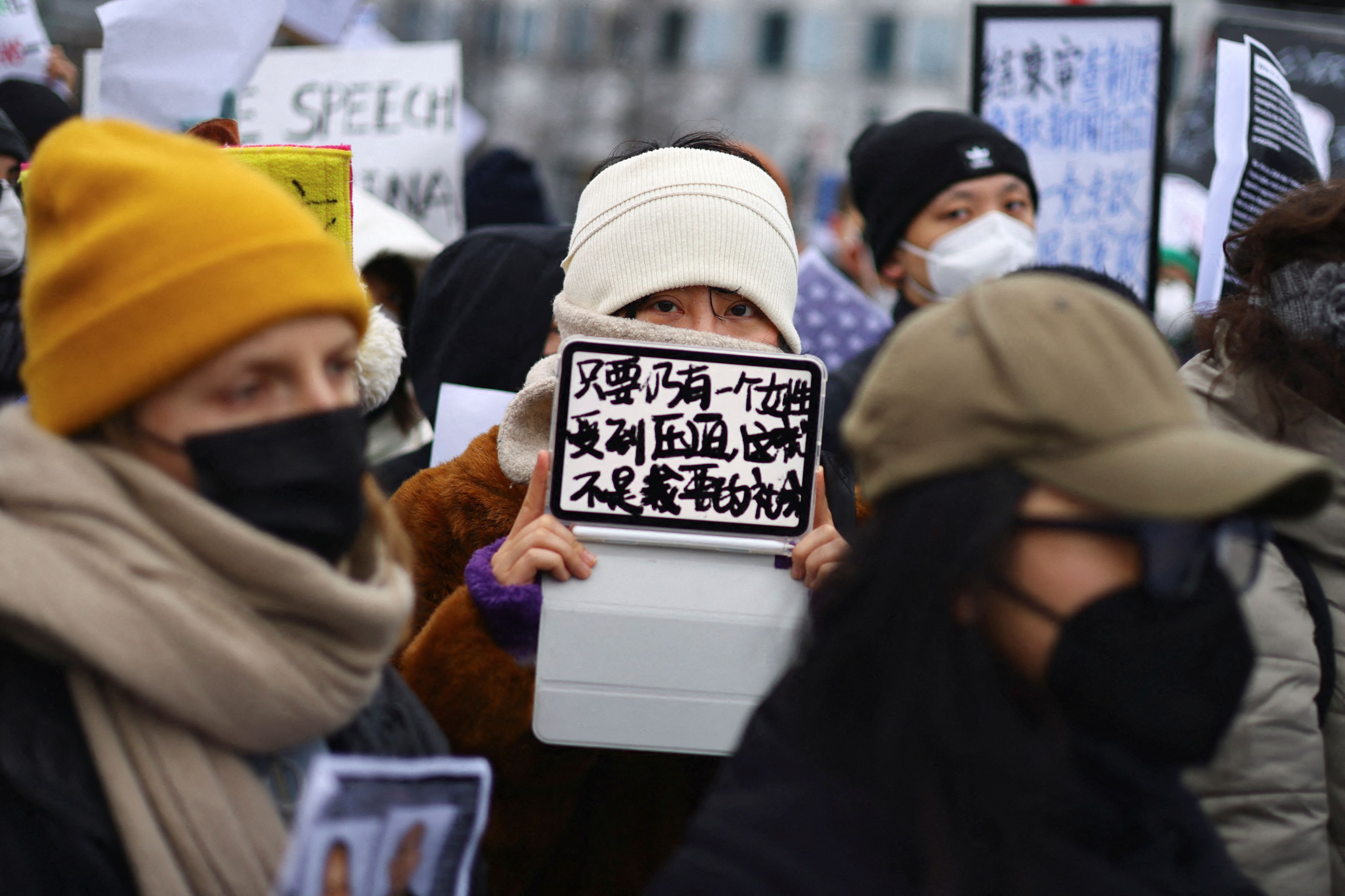
The background pages of the independently run magazine Mangmang are a dark green; not a tender green of delicate sprouts, but the deep green of hardy grass that can be seen growing everywhere.


Mangamang's signature green.
Mangamang's signature green.
In early spring of 2023, the White Paper Movement of protests against COVID lockdowns was in its nascent stage and the first issue of Mangmang magazine, "Leave Blank Space for Freedom," became a topic around the world. At that time, a reporter from WhyNot conducted an exclusive interview with Mangmang in Germany. Not long after, we learned that there were security issues among its internal members, and the website was attacked and taken down. It wasn’t until August that we saw them again.
Chinese officials have been paying close attention to Chinese Students movements overseas that echoed the domestic White Paper Movement. The Chinese authorities continue to put pressure on overseas Chinese participants through various channels. Beginning in February and March this year in China, those family members of some overseas Mangmang participants were contacted and questioned by the police. Contributing authors were also subjected to similar searches. As an independent Chinese magazine born in the upsurge of overseas protests, the fact that Mangmang is raising official alarm bells indirectly illustrates its influence.
Frank, a member of Mangmang, recalled one such incident when a member was questioned by a customs agent upon returning to China. “Mangmang was born in the protest, so of course he has to have something to do with the activists. One of the activists was found when he returned to China. He was questioned a lot when he entered the China Customs – even though this person was a German citizen." This incident sparked media reports in Germany, and the aftershock shook the team.
According to Frank, everyone was scared after this incident and some members chose to quit. “It caused a lot of damage to the editorial department at the time,” Frank said. He believes that the departures may not seriously affect editorial work, but that "fear" has caused great damage to the team.
Internally, Mangmang’s editorial team was able gradually resolve the crisis by establishing stricter security rules, analyzing the sources of danger and tightening the work process. "But in the community where Mangmang was born, there were more reservations. The community is not a working team. The community cannot pass safety regulations to ask everyone to do certain things," Frank said. And when safety factors were inconsistent in the community, mutual suspicion arose, some public events had to be canceled, while many members became paranoid. With no way for everyone to heal together at the time, fear easily turned into suspicion and worry.
"Because this (surveillance) system was unknown, everyone became very sensitive to any possible signs of threat. Many people disappeared and quit during this period and never spoke again. In addition, the tide of protest at that time also hit a bottom low. The situation was a new blow to those who wanted to stay and continue to work." Frank recalled.
"We felt powerless,” he told WhyNot.
Recalling that period of time, Frank said "Actually, whether it was the White Paper Movement or the Sitong Bridge, everyone saw each other, merged into a crowd, and could trust each other. That was a way to do things together. The process of gaining a sense of strength. Yet the suspicion brought by fear is like watching the tower you built with your own hands tumbling down little by little."
A friend, whose family had been harassed, described what he called the "shape of fear" to Frank:
"It's scariest when the fear doesn't materialize, but only has a vague outline. You magnify the fear, which can lead you to imagine that totalitarian government is omnipotent."
Conversely, said Frank, "If this fear became tangible, for example, if your parents were actually harassed, you may not be afraid anymore, because you find that the fear has become visible, and it’s no longer the omnipotent figment of your imagination.”
Frank said that after these encounters, some people who had been tracked down began to feel relieved, regained their courage and carried on their lives as usual.
He believes that overcoming fear requires more of a collective effort. "You have to share your fears with your close comrades and partners. You need to talk to each other. After recognizing that we all share the same fear, then we can help each other settle our minds. Then everyone can discuss solutions together."
Frank believes that this is a very important step in teamwork, signifying the process of transforming individual random protesters into activists.
“It makes you aware of all the risks, what kind of opponents you face, and how long term this endeavor may be. You then start to learn the tools and knowledge to arm yourself, and you need to do a lot of things to distinguish yourself from the common protesters. You may have to accept that you will always be anonymous, you will always present yourself to the world under a pseudonym, and you may have to give up public expression.”
For the Mangmang team, this was critical confirmation of their identity. From the beginning of the magazine’s founding, they officially became international actors within the greater Chinese speaking community. They needed to learn how to build close teams, how to train with security tools, and how to internalize a wealth of international experience into methods suitable for Chinese activists.
The spring breeze revived Mangmang, which was already preparing the second issue of the hardcopy magazine.
"The hardcopy magazine was our intention all along. Once it’s produced, it won’t be erased, and its existence is verified," Frank said. An online revised edition was also underway. The early Mangmang website suffered numerous cyber-attacks and had to be taken down. Then, experts volunteered to help them build a more secure website. Frank believes that this was also an important horizontal connection.
"Chinese protesters must also learn from activists in Afghanistan and Iran, and from the independent media in Russia and Hong Kong."
Diaspora Media, Amateur Writing, and Activists


Starting out again, Mangmang found a clearer path for its development. The first marker on that path was its position as “diaspora media.” Hong Kong's Like Water gave them inspiration and they positioned themselves as "serving diaspora communities that do not fit in with the mainstream narrative." This was also the identity construct of their team. "We are far away from our homeland, and at the same time we are concerned about issues in our hometown. But we must also pay attention to the living conditions of the overseas Chinese around us."
They understood that the power of diasporic media and communities is limited. They had to pay attention to peoples who went through similar situations, similar regional events and similar patterns around the world. Then they can build International solidarity. They must understand international issues such as Iran and Afghanistan, and to understand Hong Kong and issues about the ethnic Uyghurs and the ethnic Tibetans.
The second role of Mangmang was for "amateur writing." In addition to using professional journalists to examine issues, Mangmang also hoped to report from the perspective of activists, narrating news and events in the voice of activists.
"We didn’t think that we had to examine the news with very objective journalistic professionalism, but to understand the community and the stratosphere we live in from the perspective of the activists themselves. To understand what everyone is concerned about, what their interests are... to become an information medium that serves these people.”
Their third identity was still as activists. "We are first activists, and we orient ourselves and view the world from the perspective and identity of activists. We would put more attention on the evolution of social movements and issues of social justice." In the future, the Mangmang team also wants to transform from a volunteer organization into a professional NGO to promote long-term operations.
"Nowadays, everyone pays more attention to the concept of a civil society, which China failed to establish, rather than simply replicating the political opposition actions of the older generation. It is not like forming a political party or building an army, nor is it writing a revolutionary program and designing a model of operations,” he said.
“What we have observed is that everyone will focus on the community around them. For example, Chinese who gather in a particular area who share similar political frustration and public concerns will try to establish some platforms that provide a space for everyone to exchange and discuss ideas,” Frank said.
Following an interview in an article with Huang Taiyang (a Hong Kong pro-democracy activist), a reader left a message, "As a Chinese Mainland dissident who considers himself homeless and the last generation of Mainlanders, how do you find and define your own identity?"
"There’s freedom within [this notion of being] separated, you’re marginalized through this separation, looking for a home in separation... If there is such a home, real and not empty, just and free, I will be a member of such a home," Chuang, a member of Mangmang responded.
The 'Hot Wind' of the New York Democracy Salon

The Democracy Salon in New York officially changed its name to "Hot Wind" recently. In an announcement about its name change, the founder stated, "A grand name like 'Democracy Salon' cannot truly reflect the content of our activities and the mission of the organization. Therefore, we decided to rename our organization after the title of Lu Xun's collected works, and we will continue to form a diverse community that shares the common concern about China; that is warm and inclusive, and that invites young people to support each other and get rid of the ‘cold air’ together."
Lu Xun's "Hot Wind" collection of essays was created during the years after the 1919 May 4th Movement in China, when ideological trends arose, debates raged and the cultural world was full of ruthless cynicism and affectionate satire.
At that time, Lu Xun felt that "the air around him was too cold," so he gladly began a conversation with himself, calling it "Hot Wind.” On the first anniversary of the White Paper Movement, various places are facing the ebb of enthusiasm for the movement and young people are returning to "air-conditioned rooms." The namesake of "Hot Wind" can’t help but remind people of its "play on words," inviting young people to continue following affairs about China.
Qiu Jing and James are two managers of Hot Wind. China’s epidemic control and the White Paper Movement allowed the two, who used to be more concerned about local issues in the United States, to regain their identities related to China. “As soon as the Pandemic outbreak erupted, I realized that in a globalized world, what happened in your homeland would still affect you,” said Qiu Jing.
"After the White Paper protests ended, our thinking was a bit like that of the early 1970s. It was like everyone began to think critically about this authority and no longer believed in it. In the 1970s, educated youth began organizing reading groups. Those participants all went on to participate in many social movements such as the April 5th Movement and the Democracy Wall," James said, seeing the present as similar to those 1970s movements. They started the Democracy Salon because they wanted to bridge the generations together, and they wanted people from different backgrounds and ethnic groups to use Chinese topics to connect and continue the movement.

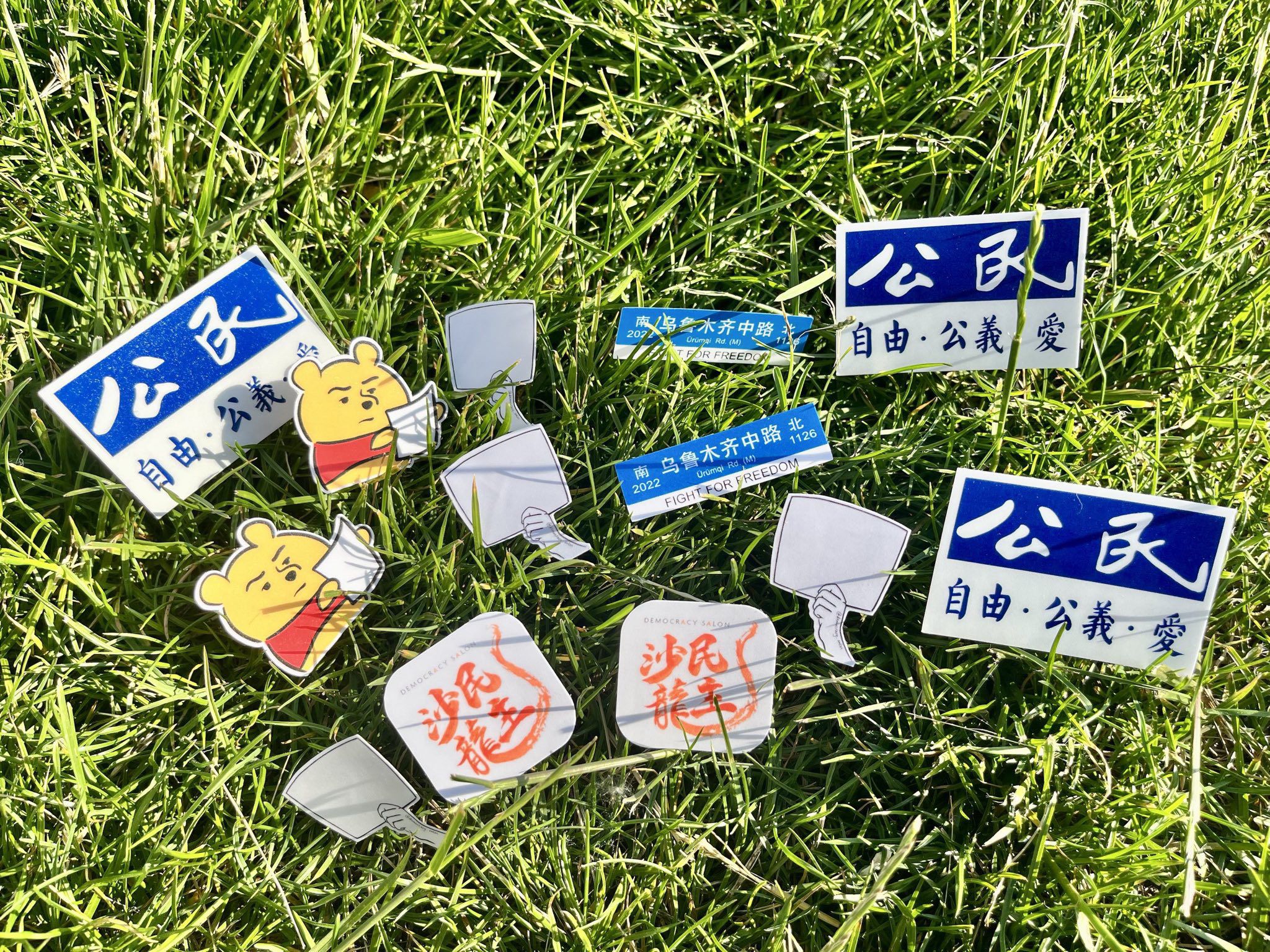
Souvenirs from the picnic event. (Provided by interviewee)
Souvenirs from the picnic event. (Provided by interviewee)
"It's not like now that the Pandemic is over, we can go back to a so-called normal life. In reality, it has never been normal,” he said.
"In China, people have been so walled-in; it’s so difficult to transmit information,” said Qiu Jing. “So many people have been sentenced, and the situation (for free expression and activism) is very difficult. Having been situated overseas, we are relatively free. We speak Chinese. I grew up in China and have the background, knowledge and understanding. If we don’t talk about China’s issues, who will?”
From its first issue, Hot Wind relied on the established Chinese communities in New York that have focused on such issues such as the democracy movement, women's rights, labor, and art. They invited Hu Ping, Wang Juntao, and other veteran democracy activists to talk about the 1980 Peking University election campaign. Their latest issue invited friends of Huang Xueqin and Wang Jianbing to talk about actions and practices within China. Hot Wind has since organized more than ten lectures in New York, covering a wide range of topics from labor to women's rights, from Hong Kong to Xinjiang.
Hot Wind hopes to expand more as a public group. The most important principle for every event is opposing sexual harassment and against discrimination.
The topic naturally turned to 1989 Tiananmen Square student protest leader Wang Dan's sexual harassment allegation.
"After Wang Dan's incident, we immediately issued a statement to oppose (his behavior)." On the eve of June 4th, 2023, as soon as the news came out that Wang Dan was accused of sexual assault and harassment, the Democracy Salon, an organization in close contact with Wang and the June 4th Memorial Museum, immediately issued a statement that expressed concern and support for survivors of sexual violence and called on Wang to actively respond to the incident and assume legal and moral responsibility. The stance caused Wang and the June 4th Memorial Museum to immediately cancel a Democracy Salon event at the Memorial Museum.
This setback did not affect the operation of the Democracy Salon, but instead, it helped the team to clarify and confirm their common values and principles.
"Despite the setbacks that we encountered with Wang Dan and the Memorial Museum, they actually helped us. Our entire team became more united. I said at the time that we had a 'group soul.' The more we worked, the more similar our concepts became. The more I did it, the more I felt it," said Qiu, whose enthusiasm grew as she talked.
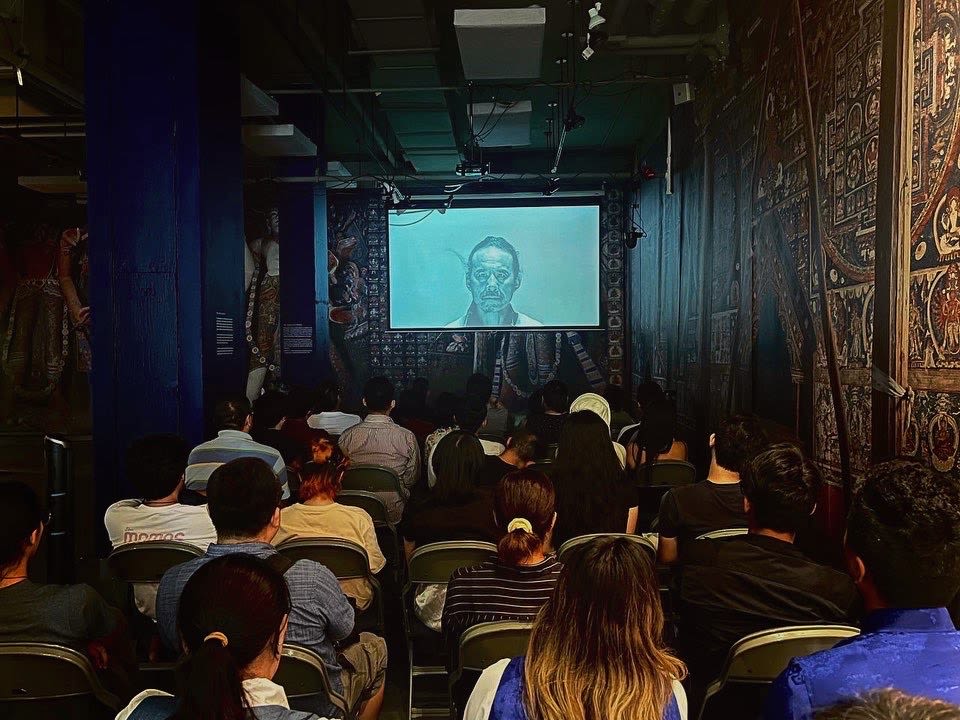
From the beginning, the Democracy Salon has favored offline, face-to-face communication. They have held picnics, film screenings for Tibetan film director and screenwriter, Wanma Tseden [aka Pema Tseden], and gathered to sing the Hong Kong protest anthem "Glory to Hong Kong" together.
They say they hope that participants can put aside their labels and share their personal experiences, so that the audience can have a sense of resonance. The event that Qiu remembers most is inviting Jewher Ilham — whose father, Uyghur political prisoner Ilham Tohti, was sentenced to life imprisonment for separatism by the Chinese authorities — to talk about her father and the situation of the Uyghurs in exile.

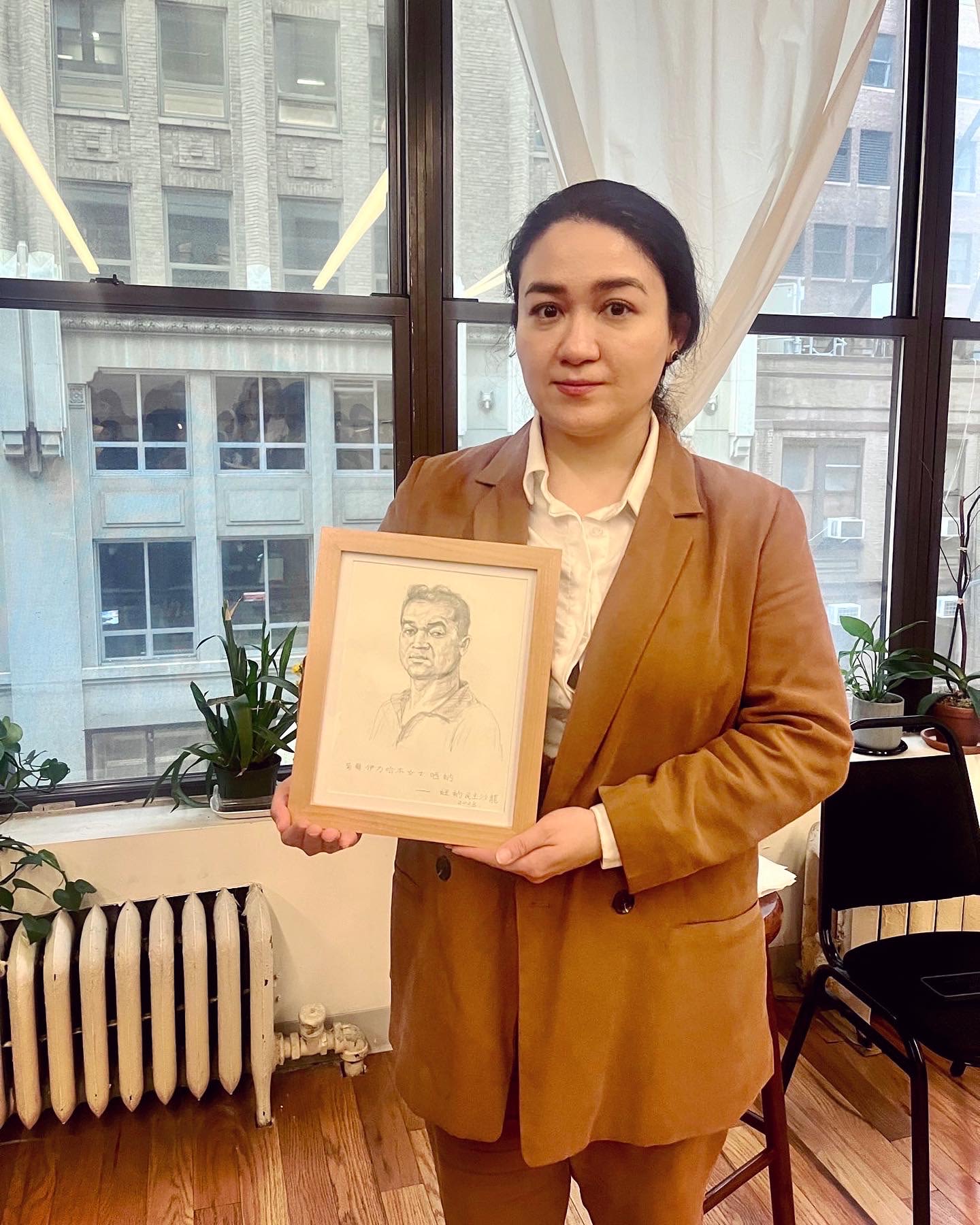
Jewher Ilham at the Democracy Salon (Provided by interviewee)
Jewher Ilham at the Democracy Salon (Provided by interviewee)
In addition to talking about her father, his moderate political views, and his imprisonment, Jewher Ilham also shared her own personal story as a Uyghur who was forced into exile.
Qiu Jing recalled that when she and Jewher first started their exchanges, they remained "a little distant," but both took preparations for meetings together seriously. "I saw that she posted a short video on Instagram to teach us how to pronounce the English word Uyghur, because many people just pronounce it 'Vegar', and Americans might pronounce it 'Yogurt', which doesn’t make sense."
They invited Jewher to teach the audience on site. Starting from small details like this, the cooperation between the two gradually became smoother. The Salon asked Jewher to speak in Chinese, and she expressed her understanding and wasn’t opposed to it. Afraid that she would not be fluent in Chinese, the Salon host used the Q&A format and shared a list of questions with Jewher in advance so that she could be fully prepared.
The Democracy Salon considers that event to be its most successful, because of the atmosphere of mutual respect and understanding.
"Jewher said that during the White Paper protests, she still had doubts and maintained a wait-and-see attitude towards this movement. In the past, many pro-democracy activists of the older generations took a Han-centric approach in their social movements.. They were 'a bit condescending', and they would think that by they were doing the Uyghurs a favor by caring about their issues," said Qiu. “When Jewher saw the questions sent to her by the Salon, she sensed progress and respect, and she also began to follow "Northern Square” on social media.
Qiu deeply empathized with the personal stories that Jewher shared, she said.
"She hopes that everyone will be mindful when buying goods and be sure not to buy things that may come from Xinjiang. When she sees such goods, she thinks of her relatives and aunts making these things from inside of a prison. Whenever she think of this thought, she couldn’t let herself make that purchase."
These small personal stories are connected and shared by Hot Wind's Salon activities.
Only part of Lu Xun's words are quoted in "Hot Wind." The original text says: "So I am always afraid. I hope that all young Chinese people will cast off the air conditioning and walk forward. They don't have to listen to the words of those who give up on themselves. Those who can do things shall take actions, while those who can make a sound will voice their ideas. If there is a bit of heat and a speck of light, even as dim as that of a firefly, it can bring some light to the darkness, rather than sitting to wait for a burning torch."
China Deviants: Seeking Continuation Within Evolution

"On Oct. 29, the overseas Chinese held protests in London, and that was our first event. Two hundred people came and shouted like fireworks suddenly blooming in the night sky."
This statement was the first social media post by China Deviants, a Chinese organization in the UK. Since October last year, there have been three events in support of the "White Paper Movement" in the UK.
After the protests, China Deviants organized a memorial event for Li Wenliang, the ophthalmologist who issued the earliest warnings about early COVID-19 infections in Wuhan, as well as a performance at the June 4th Square.
Each time, Evelyn, a member of the China Deviants, would come to the scene and shout slogans with a loudspeaker. A year has passed since the start of the protests, and the former student-led organization intends to evolve into a larger-scale charitable legal entity. The members have matured from "blank pieces of paper" to seasoned experts in carrying out protest activities.
In the past, overseas Chinese always kept a low profile. Apart from the annual "June 4th" commemoration activities, organized protests were rarely seen. Evelyn believes that feminist awareness is an indispensable part of becoming a citizen. “The awakening of many young people’s civic consciousness may have begun when they were exposed to feminist ideology in China. By the time of the ‘White Paper,’ there were also many feminists, including myself. I would like to do feminist work, because feminism is a very self-empowering process."
After the White Paper Movement, ideas of resistance among overseas Chinese students that had been dormant for many years were awakened and united. Maintaining this enthusiasm has become the strategic focus of some organizations.
“After the respective activities on Sitong Bridge and on Human Rights Day, everyone felt that some workshops were needed to maintain community connections,” Evelyn said. Recently they held a workshop to discuss oppressed groups in China – Hong Kongers, Tibetans, Uyghurs, Taiwanese and feminist groups – all threatened by China’s oppressions and intimidations, to see how everyone could generate their own perspectives under the suppression of an official narrative.
On the first anniversary of the White Paper Protest, China Deviants collaborated with Europe-based organizations and students. This included Jiang Bu, a student at the Paris School of Arts who once supported the White Paper Protest in France, to solicit ideas from global creators related to "public issues" and artistic creations related to “social action.” The works will be loaded on trucks and driven from London to Paris, Berlin, Milan, and other places for display.
Jiang revealed to WhyNot that he has currently collected 40 to 50 pieces of work, Among which, 70 to 80 percent are from Chinese students studying in Europe, with the rest from within China.
"There was an artist who interviewed seven people who had participated in the White Paper movement, and then the artist used VR glasses to create 3D models of their experiences, allowing the audience to live through that experience as if they had been there themselves,” he said.
However, Jiang said that some of the Chinese artists who had submitted work told him they had come under pressure from the Chinese authorities and withdrew their submissions.
After one year of operation, China Deviants also started to pay attention to online security issues.
Anyone who registers online undergoes a simple background check. Evelyn suspected that she had been followed and even targeted by the Chinese Embassy.
“I received a very strange phone call from the Chinese Embassy. The man asked me, ‘Are you feeling well?’ and I said, ‘I’m fine. Yeah', and then hung up. This is like saying, 'I know who you are, be careful!'."
Despite the implied threats, she believes that because the White Paper Protest was the first nationwide protest after the Tiananmen movement, it must be honored.
"If you don't remember the first anniversary, there won't be a second anniversary. Eventually, it will disappear. Therefore, I won't be intimidated because of a slight threat. It will encourage us to do even more because that oppression means that our activism is successful."
Evelyn revealed that China Deviants hopes to become a charitable incorporated organization in the future. In addition to being more transparent about its income and expenditures, it can also engage in more government lobbying efforts.

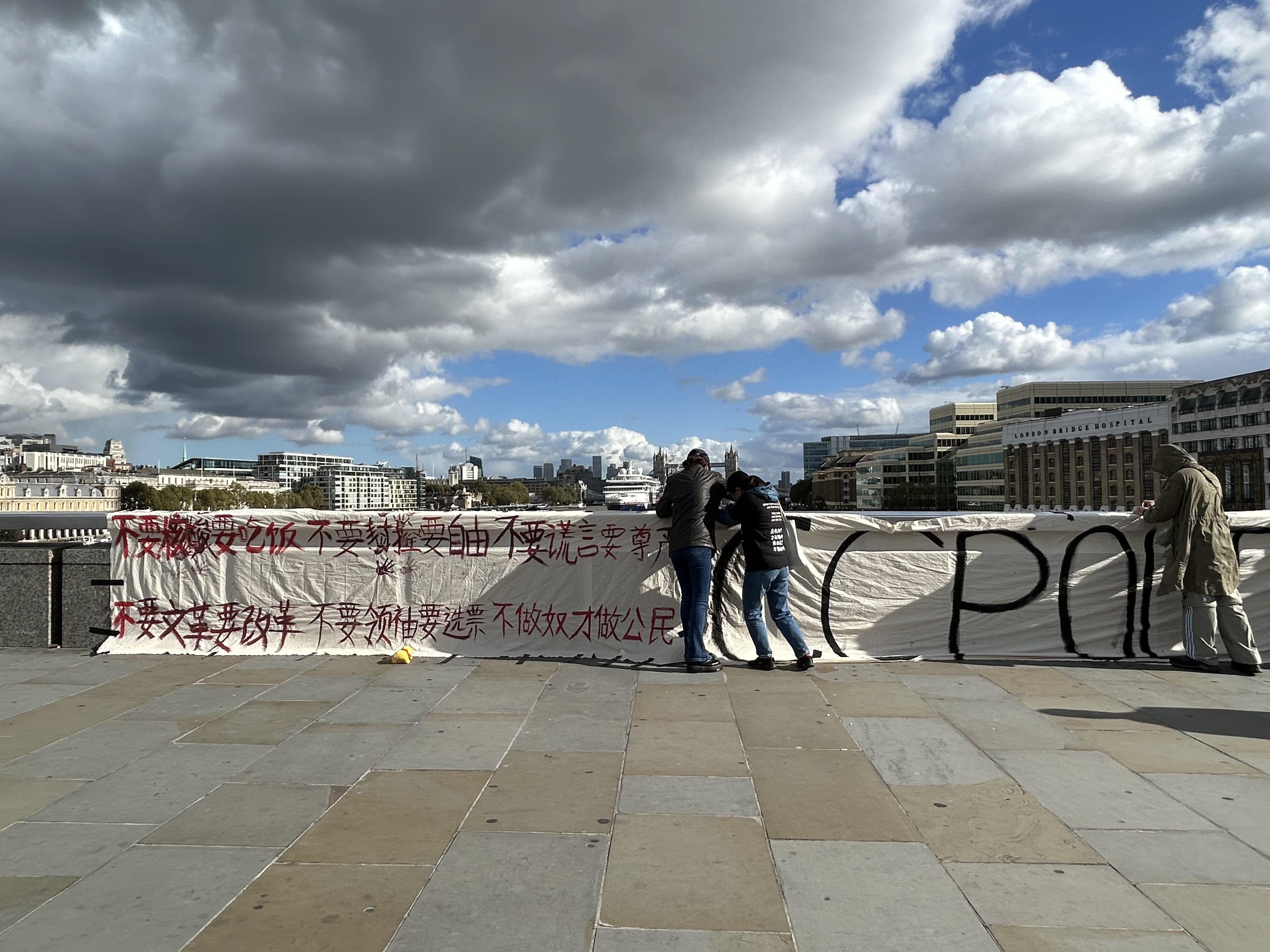
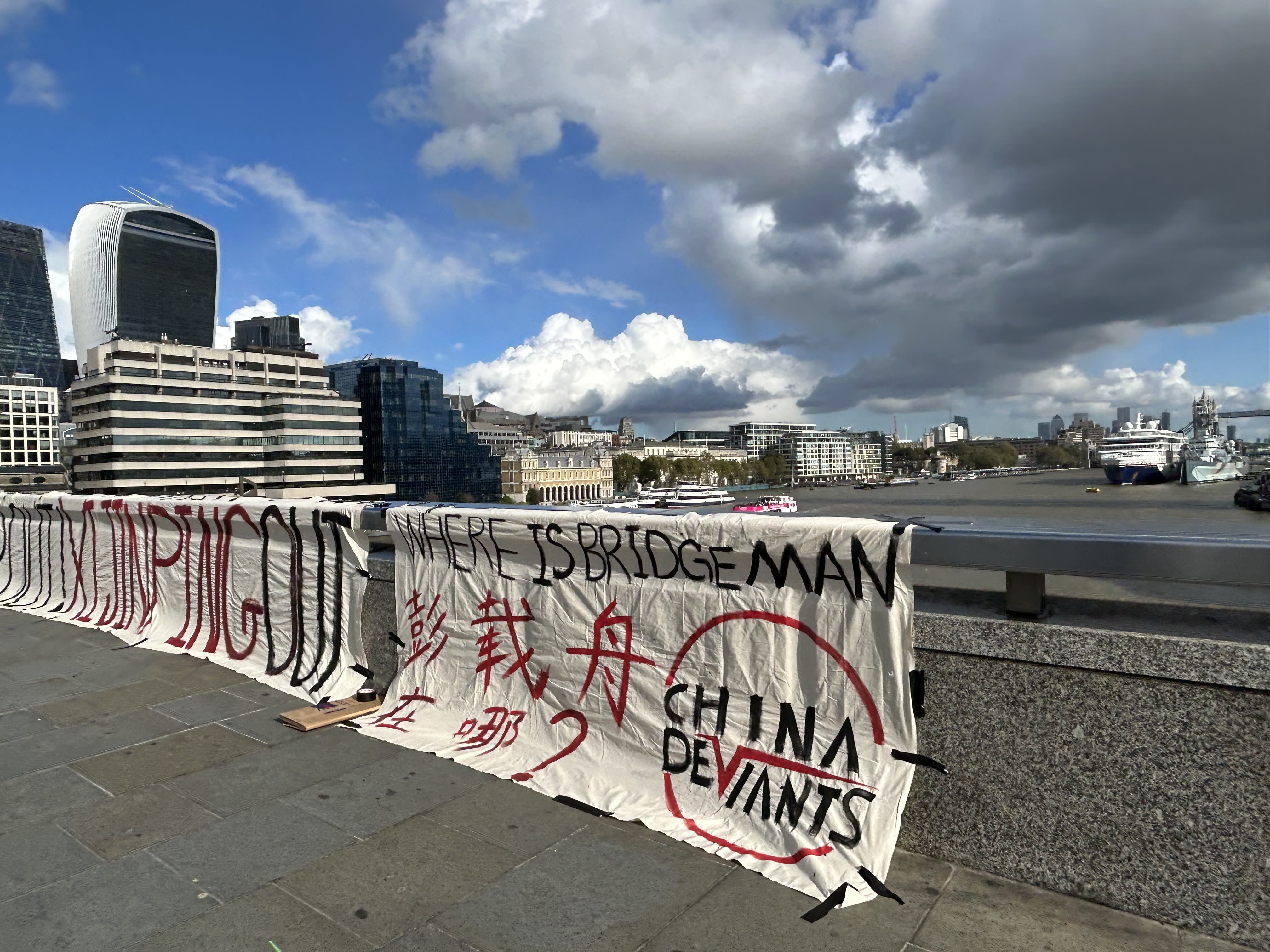
The China Deviants held a flash mob in mid-October, imitating Peng Zaizhou's banner hanging on Sitong Bridge in Beijing last year. (Chen Qi)
The China Deviants held a flash mob in mid-October, imitating Peng Zaizhou's banner hanging on Sitong Bridge in Beijing last year. (Chen Qi)
China Deviants’ social media platform has been followed by more than 2,000 people, up from only a few hundred follows a year ago. The number of members has not increased significantly, though. This may be due to the highly transient nature of the overseas Chinese community in London and the fact that it is mainly Chinese students who study abroad. However, after the White Paper Movement, Overseas Chinese students became more active organizers of offline activities this year. Among them, there is a couple who go by the alias of “Winsor” and “404.”
Shortly after 404 graduated, Shanghai was locked down for many months due to the COVID-19 outbreak.
“Various problems arose at that time, including not enough food, and the quality of the food was not very good... Everyone’s anger brew, and then people began gathering at the gates of their apartments, asking the government to lift the blockade, or to allow us to move freely,” 404 told WhyNot. It was then that 404’s anti-government ideas began to emerge.
The Beijing Sitong Bridge incident “shocked me, but I still didn't have the courage to join. On the day of the White Paper protest, the tides began shifting for the crowd, which allowed me to participate in a movement like this for the first time."
404 recalled that at about 10 pm on Nov. 26, he left his apartment and walked alone to the crowd to observe the moment of silence. At that time, some people lit candles and others handed them blank papers. He stayed until 5 or 6 AM the next morning, when the police began to disperse the crowd and even responded to demonstrators with violence. He was one of the people detained by the police.
He said that his "anti-government heart" reached a critical point at that moment. "I knew this regime was rotten, but I didn't expect that it would develop straight until the end, with many people taken away and beaten."
In September 2023, when 404 arrived in the UK to begin studies in the following month, the first thing he did was to attend an anti-CCP rally on Oct. 1 with his girlfriend Winsor, who also studied art abroad. They got to know the members of China Deviants and offered to organize the "Sitong Bridge First Anniversary" event.
Both of them say they believe that participation in civil movements abroad is more free, with relatively few constraints. However, they say the number of participants is still not ideal. A flash mob demonstration, where banners were hung on London Bridge on the first anniversary of the Sitong Bridge protest, drew no more than a dozen people. They say that the White Paper Movement may have been suppressed for too long domestically and has already hit a critical boundary where it can’t spread out of control.
“The domestic White Paper Movement has a strong influence and a wide range of fluctuations, but overseas, it is mainly a commemorative event to draw more attention from different organizations internationally.”
They told WhyNot that they hope to continue to participate in civil movements in the UK in the future and hope to spark more people's political awakening and enable civil movements to blossom everywhere.
(To protect the identity of the interviewees, pseudonyms were adopted.)
 Built with Shorthand